
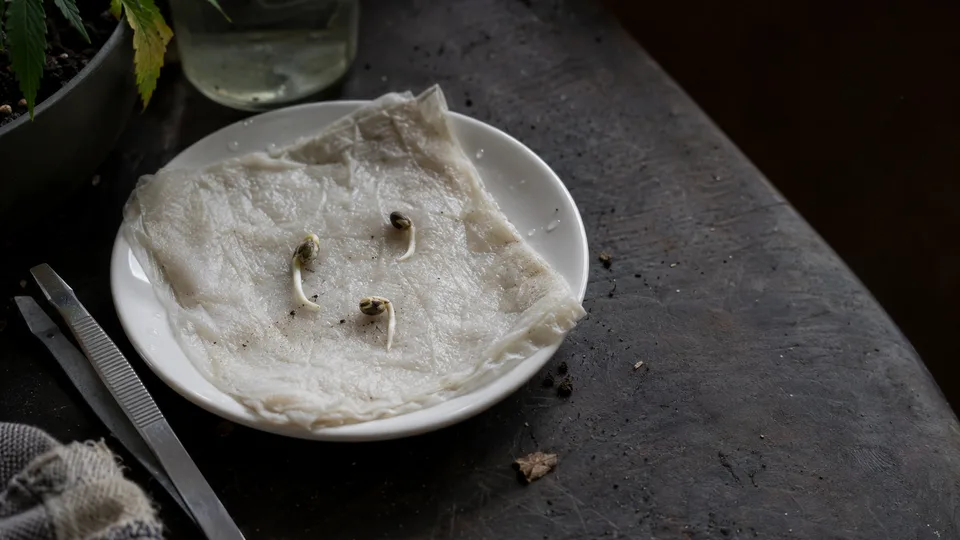
A seed needs moisture, warmth and air. Three methods that provide all three, the mistakes that stop seeds sprouting, and what to do in the first week.
Germination is the moment a seed wakes up. Water passes through the shell, the embryo swells, the shell splits and a white root tip, the taproot, pushes out. Everything after that depends on this first step going well, and it is simpler than the number of methods online would suggest.
A healthy seed needs three things: moisture, warmth and air. Every method below is just a way of providing those. Most failures come from too much of the first and too little of the third.
In short
- Keep seeds at 72 to 79°F (22 to 26°C), moist but never sitting in water, in the dark.
- Most seeds show a taproot in 24 to 72 hours. Give slow ones up to 7 days, and older seeds up to 10.
- Plant when the taproot is about a quarter to half an inch long (0.5 to 1 cm), root pointing down, a quarter to half an inch deep.
- Handle sprouted seeds with clean tweezers or not at all. The root tip is fragile.
Before you start
- Wash your hands and use clean tools. Mold is the main competitor at this stage.
- Use plain water. Tap water is fine in most places. If yours is heavily chlorinated, let it stand for a few hours. No nutrients.
- Prepare the pots first. A light seedling mix, moistened so that it holds together when squeezed but does not drip. Rich potting soil with added fertilizer can burn seedlings.
- Label everything if you are starting more than one strain.
Method 1: paper towel
The most popular method, because you can see what is happening.
- Moisten two sheets of plain paper towel and wring them out so they are damp, not dripping.
- Lay one on a plate, place the seeds an inch (2 to 3 cm) apart, and cover with the second sheet.
- Cover with another plate turned upside down, or slide the plate into an unsealed plastic bag, so the towels stay moist but air can get in.
- Put it somewhere warm and dark: 72 to 79°F (22 to 26°C). The top of a refrigerator or a shelf near, not on, a heat source often works.
- Check once or twice a day. Re-moisten the towel if it begins to dry. Do not let it dry out.
- When a taproot is a quarter to half an inch long, plant the seed.
Watch out for: roots growing into the towel if you wait too long. If that happens, cut around the root instead of pulling it free.
Method 2: soak, then plant
Useful for seeds with hard shells and for older seeds.
- Drop the seeds into a glass of lukewarm water, around 72°F (22°C). They will float at first.
- Leave them in the dark for 12 to 18 hours. Most will sink as they take up water. A gentle tap helps those that do not.
- After no more than 24 hours, move them on. Seeds left in water longer run out of oxygen and drown.
- Plant the soaked seeds directly into moist seedling mix, or continue with the paper towel method until a taproot shows.
Some seeds crack open and show a root tip while still in the glass. That is fine. Plant them straight away.
Method 3: straight into the final medium
The most natural method and the gentlest on the seedling, because the root is never handled. It is a good choice for autoflowers, which do best when started in their final pot.
- Fill the pot with a light mix and moisten it evenly.
- Make a hole a quarter to half an inch deep (0.5 to 1 cm) with a pencil.
- Drop in the seed, cover it loosely, and do not press the soil down hard.
- Cover the pot with clear wrap or an upturned clear cup to hold humidity, and keep it at 72 to 79°F.
- Keep the surface moist with a spray bottle. Do not pour water over it.
- Seedlings surface in 3 to 7 days. Remove the cover when they do.
Starter plugs and peat pellets work the same way and make transplanting easy.
Planting a sprouted seed
- Make the hole first. Hold the seed gently by its shell with tweezers, never by the root.
- Place it with the root pointing down. If it is curled, do your best. The plant will sort itself out, but it costs energy.
- Cover lightly with loose mix, a quarter to half an inch deep. Deeper planting is a common reason seedlings never surface.
- Mist the surface. Do not water heavily.
The first week
- Light. As soon as the seedling is above ground, it needs light. A sunny windowsill works for a few days. A grow light at a gentle setting or a good distance is better. Pale, tall, thin seedlings are stretching for more light.
- Water. Little and often, in a small circle around the stem. The pot should feel light before you water again. Overwatering is the most common cause of seedling death.
- Humidity. Seedlings like 65 to 75% humidity. A clear dome for the first few days helps, with daily airing.
- No fertilizer for the first two weeks. The seed carries its own reserves, and the two round first leaves are its food supply.
- A stuck shell. Sometimes the shell stays clamped on the first leaves. Moisten it with a drop of water, wait a few minutes, and ease it off with tweezers. If it resists, wet it again and wait.
Troubleshooting
| Problem | Likely cause | What to do |
|---|---|---|
| Nothing after 5 days | Too cold, too dry, or an old seed | Check temperature. Try a 12-hour soak. Give it until day 10. |
| Seed is soft, dark or moldy | Too wet, not enough air | Discard. Wring towels out more next time. |
| Root tip turned brown | Dried out or was damaged | Plant it anyway. Some recover. |
| Sprout emerged, then fell over at the soil line | Damping off, a fungal problem in wet, still conditions | Water less, add air movement, start with fresh mix. |
| Tall, pale, thin seedling | Not enough light | Move the light closer. Bury part of the stem when you pot up. |
Helping older or stubborn seeds
Seeds more than a few years old often have a hardened shell and slower metabolism. Three things can help, in this order: a longer soak of up to 24 hours, a tiny amount of hydrogen peroxide in the soak water (a few drops of the 3% kind per glass) to soften the shell and suppress mold, and lightly scuffing the shell by shaking the seed for a moment in a matchbox lined with fine sandpaper. None of them can revive a dead seed, but they help a slow one.
Frequently asked questions
How many seeds should I start?
One or two more than the number of plants you want. Good fresh seeds germinate at 85 to 95%, which still means the odd one fails.
Do I need a heat mat?
Only if your room is below about 68°F (20°C). If you use one, check the temperature with a thermometer. Mats without a thermostat easily overheat a plate of seeds.
Do seeds need light to germinate?
No. They germinate in the dark. Light matters from the moment the seedling breaks the surface.
How long do cannabis seeds take to germinate?
Most show a taproot within 24 to 72 hours. Give slow seeds up to 7 days, and older seeds up to 10.
How deep should I plant a germinated seed?
A quarter to half an inch deep (0.5 to 1 cm), with the root pointing down, covered loosely. Planting deeper is a common reason seedlings never surface.
What is the best temperature for germination?
Between 72 and 79°F (22 to 26°C). Below about 68°F (20°C) germination slows down sharply.
Next step
If a pack fails to germinate, check the shop's germination policy and keep the original packaging. And when you choose your next seeds, remember that fresh stock from an established shop is the best predictor of a good start.
Ready to compare prices?
Compare every seed type by price per seed across seedshops.