
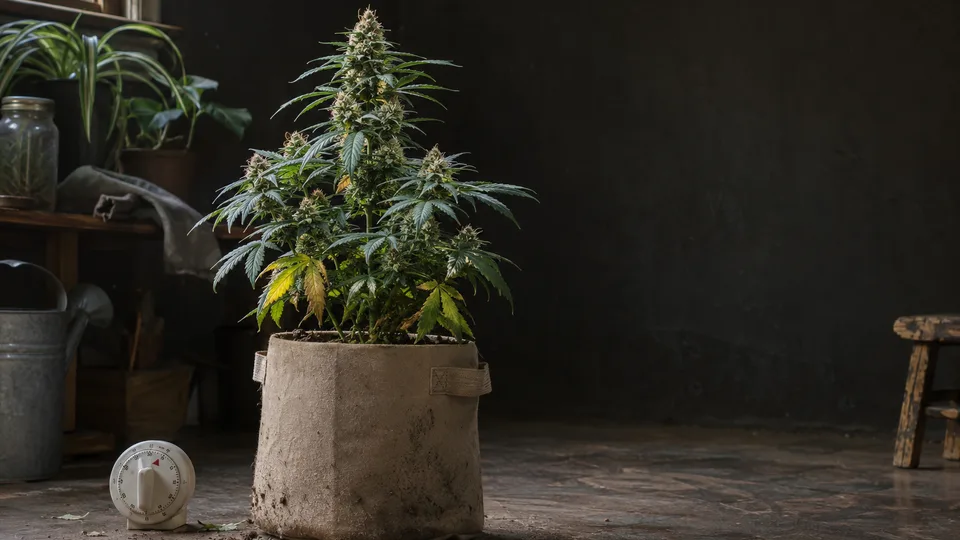
An autoflower runs on a clock you cannot pause. A week-by-week look at what happens, and how to avoid losing yield in the first three weeks.
An autoflower is a cannabis plant that starts flowering because of its age, not because the days are getting shorter. That single trait changes almost everything about the grow: the timeline, the light schedule, the size of the plant, and which mistakes you can get away with.
In short
- Ready 8 to 12 weeks after sprouting, depending on the strain.
- Flowering starts by itself around week 3 to 5. You do not change the light schedule.
- Plants stay small: usually 1.5 to 3.5 ft (50 to 110 cm).
- The first three weeks decide the size of your harvest. Stress early on cannot be made up later.
Where autoflowers come from
The trait comes from Cannabis ruderalis, a wild type from Central Asia and Eastern Europe, where summers are short and days are very long. A plant that waited for short days there would be killed by frost before finishing. Ruderalis flowers on a timer instead.
On its own, ruderalis is small and low in THC. Breeders crossed it with established indica and sativa strains and selected, over many generations, for plants that kept the autoflowering trait but gained the potency, flavor and yield of the other parent. That is why an autoflower version of a strain is never an identical copy of the original. It is a related plant that has been bred to resemble it.
This is also why Seedsbay treats the autoflower as its own seed type with its own grow figures, rather than a switch on the original strain.
Week by week
Timelines vary by strain, but a typical 10-week autoflower looks like this:
| Week | What happens | What you do |
|---|---|---|
| 1 | Seedling: two round leaves, then the first serrated pair | Keep the soil lightly moist, not wet. Gentle light. |
| 2 to 3 | Fast leaf growth, roots fill the pot | Water in a wider ring each time. Start light feeding. |
| 3 to 5 | First white hairs appear at the nodes. The plant stretches. | Any low-stress training happens now, gently. |
| 5 to 8 | Flowers build along the main stem and side branches | Full-strength bloom feeding, watch humidity. |
| 8 to 10 | Flowers swell, hairs darken, leaves begin to fade | Reduce feeding, check resin glands for ripeness. |
Breeder figures usually state "seed to harvest". Treat them as the fast end of the range. One to two weeks longer is normal, especially in cooler rooms or outdoors.
The light schedule
Because flowering is not triggered by darkness, autoflowers can have long days from start to finish. Most growers use 18 hours on and 6 off. Some use 20 and 4. Running lights 24 hours a day works but gives little extra for the electricity, and most growers find plants do better with some rest.
Outdoors this is the great advantage in northern regions. You can sow after the last frost and harvest in July or August, in the longest, driest and warmest part of the year, rather than gambling on October.
Why the first three weeks matter so much
A photoperiod plant that has a bad start can simply be given more time. You delay the switch to flowering until it has recovered. An autoflower does not wait. It will start flowering on schedule at whatever size it has reached.
That makes early stress the main reason for small harvests. The usual causes:
- Transplanting. Roots that pause for a week cost you a week you never get back. Sow in the final pot, or transplant once, early and carefully. A 3 to 5 gallon (11 to 19 liter) fabric pot suits most autoflowers.
- Overwatering seedlings. A small plant in a large pot of soaked soil cannot breathe. Water a small circle around the stem and widen it as the plant grows.
- Too much fertilizer. Autoflowers need less than photoperiod plants. Start at a quarter to half the recommended dose.
- Heavy training. Topping and heavy defoliation cost recovery time. Gentle bending and tying down of the main stem is the safer choice.
Yield and potency
Expect less per plant than a photoperiod strain, because the plant is smaller and has less time. Per square foot the difference is smaller than you might think, since you can fit more plants in the same area and run more cycles per year.
Potency used to be the weak point. It no longer is. Many current autoflowers are listed at THC levels comparable to photoperiod strains. As always, listed THC is a best-case figure from the breeder, not a promise.
What you cannot do with an autoflower
- Keep a mother plant. A cutting has the same age as the plant it came from, so it flowers immediately and stays tiny.
- Extend the growth phase. You cannot hold it back to fill a bigger space.
- Re-run a favorite plant. Every grow starts from seed, so the consistency of the breeder's seed line matters more than with photoperiod strains.
Who are autoflowers for?
- Growers with a low or small space: closets, balconies, small tents.
- Outdoor growers with a short or wet autumn.
- Anyone who wants a harvest in under three months or several harvests per year.
- Beginners who would rather not manage light schedules, as long as they are careful in the first weeks.
Frequently asked questions
Do autoflowers need a bigger pot to get bigger?
Up to a point. Below 2 gallons (8 liters) the plant is usually restricted. Above 5 gallons (19 liters) you gain little within such a short life.
Can I grow autoflowers and photoperiod plants together?
Yes, while the photoperiod plants are in their long-day growth phase. After the switch to 12-12, autoflowers will still finish but with noticeably less light than they could use.
Why is my autoflower still not flowering at week 6?
Some lines are slower, and a few seeds in any pack may lean toward the photoperiod parent. If nothing has happened by week 7 or 8 indoors, switching to 12-12 will trigger it.
How many hours of light do autoflowers need?
Most growers give 18 to 20 hours per day from seed to harvest. Autoflowers do not need a change in day length to start flowering.
Can you clone an autoflower?
A cutting will root, but it is the same age as the plant it came from, so it starts flowering straight away and stays tiny. In practice every autoflower grow starts from seed.
Can I top or train an autoflower?
Gentle low-stress training, such as bending and tying down the main stem in weeks three and four, works well. Topping costs recovery time that an autoflower does not have, so many growers skip it.
Next step
Browse autoflower seeds. Read each breeder's stated seed-to-harvest period and height on the seed page; missing figures remain unknown. Compare the same pack size before choosing a shop.
Ready to compare prices?
Compare every seed type by price per seed across seedshops.