
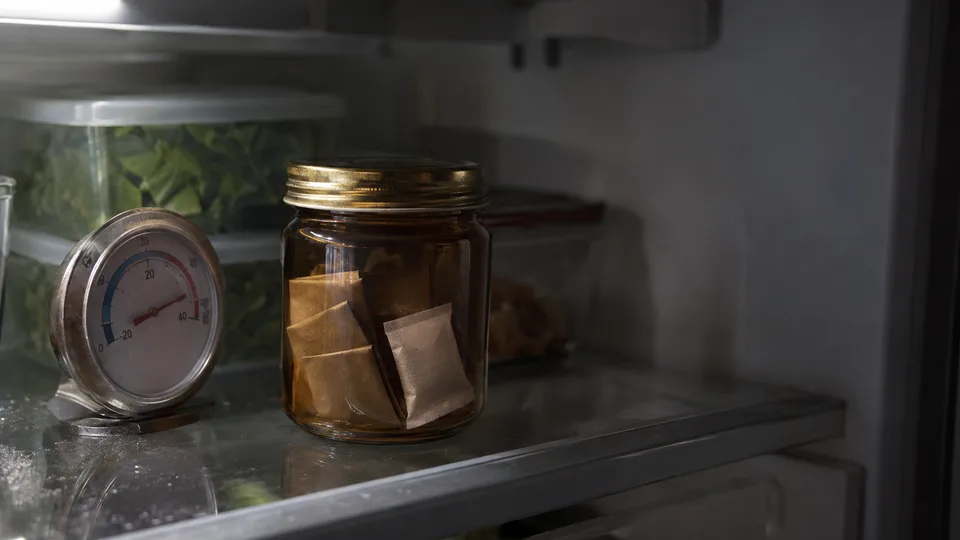
A seed is alive and slowly using up its reserves. Four conditions decide whether it lasts one year or ten.
A cannabis seed is a living embryo in a dormant state, with a small food reserve and a shell to protect it. It is not inert. Very slowly, it uses up that reserve and its cells age. Heat, moisture, light and air all speed that up. Storage is simply the business of slowing it down.
This matters for two practical reasons. Larger packs are cheaper per seed, but only if the seeds you do not plant this year are still good next year. And a special strain, once discontinued, exists only in whatever seeds people have kept.
In short
- Keep seeds cool, dark, dry and at a stable temperature.
- For up to a year, a sealed container in a cool cupboard is enough.
- For several years, use an airtight container with a desiccant in the refrigerator.
- Let a cold container reach room temperature before opening it, or condensation will form on the seeds.
- Expect good germination for 2 to 3 years with casual storage, and 5 years or considerably more with careful storage.
The four enemies
Moisture
Moisture is what tells a seed to germinate. A little humidity does not start germination, but it raises the seed's metabolism and invites mold. Seeds keep best at low relative humidity, roughly 20 to 30% inside the container. Very dry is fine. Damp is fatal over time.
Heat
Every rise in temperature speeds up aging. A widely used rule of thumb from seed science is that each 10°F (5 to 6°C) drop in storage temperature roughly doubles a seed's storage life. Room temperature is acceptable for a season. A fridge is far better for years.
Temperature swings
Swings do more harm than a steady, slightly higher temperature, because they cause moisture to move in and out of the seed and condensation to form inside containers. This is why the door of the refrigerator, which warms up every time it is opened, is a worse place than the back of a shelf.
Light and air
Light, especially sunlight, degrades seeds and warms them. Oxygen slowly oxidizes the oils inside. An opaque, airtight container deals with both.
Short-term storage: up to a year
Leave seeds in the breeder's original packaging, which is designed for the purpose. Put the packs in a small airtight container such as a jar or a sealed food box, add a silica gel sachet, and keep it in a cool, dark place: a cupboard on an inside wall, a basement shelf, a drawer away from radiators and appliances.
Avoid kitchens and bathrooms, where humidity swings daily, and attics and sheds, where temperatures do.
Long-term storage: one year to many
- Keep original packs sealed where possible. Once opened, put loose seeds into a small labeled vial or a paper envelope inside a zip bag.
- Use an airtight, opaque container. A small glass jar with a good seal, wrapped or kept in a box, or a vacuum-sealed bag.
- Add a desiccant. One or two silica gel sachets per jar. Replace or dry them once a year. Do not pack seeds in loose rice, which does far less than people think.
- Refrigerate at 39 to 46°F (4 to 8°C), at the back of a shelf, not in the door. A dedicated drinks fridge that is rarely opened is ideal.
- Label each pack with strain, breeder and date.
- Open correctly. Take the container out, leave it sealed for a few hours until it reaches room temperature, then open it, take what you need and reseal. Opening a cold jar in warm air covers everything inside in condensation.
What about the freezer?
Freezing works for truly dry seeds and is how professional seed banks store material for decades. For home use it carries two risks. If seeds are not dry enough, ice crystals rupture their cells. And every removal from the freezer brings a large temperature swing and a condensation risk.
If you freeze: dry the seeds thoroughly with desiccant for a couple of weeks first, vacuum seal them in small portions so that each bag is thawed only once, and thaw sealed bags in the refrigerator for a day before bringing them to room temperature. For most growers keeping seeds for up to five or so years, the refrigerator is safer and nearly as good.
How long do seeds last?
Reliable figures are hard to give because starting quality varies, but growers' experience looks roughly like this:
| Storage | Good germination for |
|---|---|
| In a drawer at room temperature, original pack | 1 to 2 years, declining after |
| Cool, dark cupboard, airtight with desiccant | 2 to 4 years |
| Refrigerator, airtight with desiccant, rarely disturbed | 5 to 10 years |
| Freezer, properly dried and sealed | 10 years and more |
Decline is gradual. A five-year-old pack that once germinated at 95% might now manage 70%, and the seeds that do sprout may take several days longer. Seedlings from old seeds can start a little slower but usually catch up.
Waking up older seeds
Older seeds often have a hard, dry shell and low reserves. Give them the best possible conditions: a 12 to 24 hour soak in lukewarm water, a steady 75 to 79°F (24 to 26°C), and patience for up to ten days. A few drops of 3% hydrogen peroxide in the soak water helps keep mold away during the longer wait. Lightly scuffing the shell with fine sandpaper helps water get in.
What storage means for choosing pack sizes
If you can store seeds properly, the lower price per seed of a larger pack is a real saving, provided it is a strain you expect to grow again. If your seeds will sit in a drawer, plan on using them within a year or two and choose pack sizes accordingly.
It is also a reason to prefer shops that keep their own stock refrigerated and sell seeds in original, dated breeder packaging. A pack that spent two summers in a warm warehouse is already older than its date suggests.
Frequently asked questions
Can I store seeds in the plastic tube or tin they came in?
Yes, inside a second airtight container with a desiccant. The original pack identifies the seeds and protects them from crushing.
Do seeds need to breathe?
Dormant seeds need very little oxygen. Airtight storage, including vacuum sealing, is fine for dry seeds.
How can I tell if old seeds are still alive?
Only by germinating them. Test two or three from the pack before you plan a grow around them.
Should I store seeds in the fridge or the freezer?
The refrigerator suits most growers and keeps seeds good for five years or more. Freezing works only for thoroughly dried seeds sealed in small portions that are thawed once.
What humidity is best for storing seeds?
Low: roughly 20 to 30% relative humidity inside the container. An airtight jar with a silica gel sachet achieves that.
Do cannabis seeds expire?
There is no fixed date. The germination rate declines gradually: expect good results for two to three years with casual storage and five years or more with careful storage.
Next step
Write the date on the pack the day it arrives. When you next compare pack sizes, you will know how long your seeds have really been stored, and whether the bigger pack made sense.
Ready to compare prices?
Compare every seed type by price per seed across seedshops.