
A listed THC of 28% is a best case, not a promise. How to read potency ranges, ratios and terpene profiles with the right amount of trust.
Every strain page shows a THC figure, usually a CBD figure, and often a list of terpenes. They look like hard facts. Some are firmer than others. Reading them with the right amount of trust will help you choose a strain you enjoy, and stop you paying extra for a number that means less than it seems.
In short
- THC sets the strength. Listed percentages are the breeder's best case and your own harvest will usually come in lower.
- CBD changes the character of the effect. The ratio of THC to CBD matters more than either number alone.
- Terpenes give the flavor and are the best available guide to what kind of effect a strain has.
- Ranges from several breeders are more honest than one impressive figure.
THC: the strength
THC is the main intoxicating compound in cannabis. The percentage is the share of the dried flower's weight that is THC.
| Listed THC | Roughly |
|---|---|
| Under 10% | Mild |
| 10 to 17% | Moderate; plenty for many people |
| 18 to 24% | Strong; where most popular strains sit today |
| 25% and above | Very strong; the top end of what plants produce |
Three things to know about that number.
It is a best case. Breeders quote the highest results achieved from selected plants under ideal conditions. Home-grown harvests from the same seeds commonly test several points lower. Light intensity, plant health, harvest timing, drying and curing all move the result.
Labs and methods differ. The same sample sent to different labs can come back a few points apart. Treat listed figures as accurate to within a few points either way.
More is not better past a point. Above about 20%, most people do not experience an extra five points as a better effect. It is simply more intense, with more chance of anxiety or a racing heart for occasional users. If 16% is pleasant for you, 28% is not an upgrade.
That is why Seedsbay shows THC as a range across the breeders that offer a strain. "18 to 24% across nine breeders" tells you more than one breeder's 27%.
CBD: the modifier
CBD does not intoxicate. In the amounts found in standard strains, well under 1%, it plays little role. In strains bred for it, it changes the experience noticeably: many people find that CBD softens the sharper edges of THC, and a strain with both feels calmer than its THC figure alone suggests.
The ratio is the useful number:
| THC to CBD | What to expect |
|---|---|
| 20:1 or higher (standard strains) | The full THC effect |
| 2:1 | Clearly intoxicating, gentler |
| 1:1 | A mild, balanced effect that many new users prefer |
| 1:10 to 1:20 | Little to no intoxication |
Ratios are averages for a seed line. Individual plants vary, more so in 1:1 lines, so if the precise ratio matters, only a test of your own harvest is certain.
Other cannabinoids
You may see CBG, CBN, THCV or CBC listed. They are present in small amounts in most plants and a few strains are bred for higher levels. Research on their effects in people is at an early stage. It is reasonable to be curious, and sensible to be skeptical of firm claims.
Terpenes: flavor and character
Terpenes are the aromatic oils that make one strain smell of lemon and another of pine or diesel. They are made in the same resin glands as cannabinoids, and they are common throughout nature: the limonene in cannabis is the same compound as in orange peel.
They matter for two reasons. Flavor and aroma are why many growers choose one strain over another. And terpenes appear to shape the character of the effect, which helps explain why two strains with the same THC can feel different. The research here is still developing, so treat the associations below as commonly reported tendencies, not as established medical effects.
| Terpene | Smells like | Commonly associated with |
|---|---|---|
| Myrcene | Earthy, musky, ripe mango | Relaxing, heavy strains |
| Limonene | Lemon, orange peel | Bright, uplifting strains |
| Caryophyllene | Black pepper, clove | Spicy, warm strains; also found in many "gas" profiles |
| Pinene | Pine needles, fresh resin | Clear-headed, fresh strains |
| Linalool | Lavender, floral | Calming strains |
| Terpinolene | Floral, herbal, slightly fruity | Many classic energetic strains |
| Humulene | Hops, woody | Earthy, herbal profiles |
| Ocimene | Sweet, herbal, tropical | Fruity profiles |
A strain's top two or three terpenes are fairly consistent between plants and breeders, more so than its THC percentage. If you liked a strain, note its dominant terpenes and look for others that share them. That works better than following the indica or sativa label.
Your grow affects all of it
The genetics set the ceiling. How you grow decides how close you get.
- Light is the biggest factor for potency. Weak light gives weaker flowers.
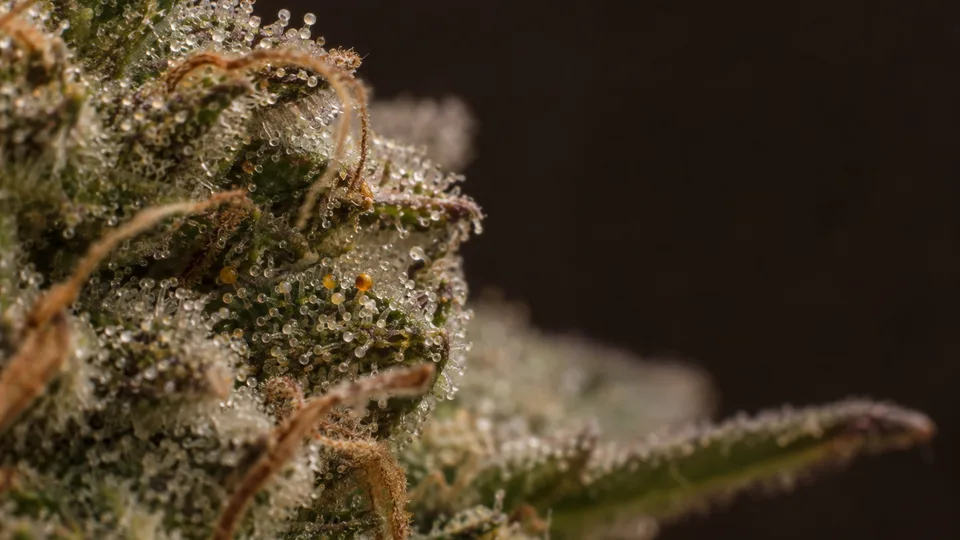
- Harvest timing matters. Resin glands go from clear to milky to amber. Most growers harvest when most are milky with some amber. Too early costs potency.
- Drying and curing protect terpenes. Fast drying in warm air strips away aroma. Slow drying at around 60°F (16°C) and 60% humidity, followed by a few weeks of curing in jars, keeps it.
- Heat late in flowering evaporates terpenes before you ever harvest.
A well-grown 18% strain is better in every way than a poorly grown 26% strain.
How to use the numbers when choosing
- Decide the strength you want and set a THC range, not a minimum.
- Decide whether you want CBD in the mix.
- Read the breeder's aroma description and any listed terpene information. These descriptions are not a promise of a particular experience.
- Read the reported effects as a check on the first three.
- Compare breeders. If one breeder's figure is far above all the others for the same strain, read it as marketing.
Frequently asked questions
Does higher THC mean better quality?
No. It means stronger. Quality is flavor, smoothness, the character of the effect and how well the flowers were grown and cured.
Why does my harvest seem weaker than the listed THC?
Because the listed figure is a best case. Several points lower is normal, and drying and curing have a large influence.
Can I test my own harvest?
In many regions, labs accept samples from private growers, and home test kits give a rough indication. Whether this is available and permitted depends on where you live.
What THC level suits an occasional user?
Many occasional users are comfortable between 10 and 17% THC, or with a 1:1 THC to CBD strain. Higher figures mean a more intense effect, not a better one.
What does a 1:1 THC to CBD ratio mean?
The flowers contain roughly equal amounts of THC and CBD, for example 8% of each. The effect is noticeably milder and calmer than a standard high-THC strain.
Do terpenes survive drying and curing?
Partly, and how you dry decides how much. Slow drying at around 60°F (16°C) and 60% humidity, followed by a few weeks of curing in jars, keeps far more aroma than fast drying in warm air.
Next step
Open a strain and look at the THC range across breeders, the THC to CBD ratio and the top three terpenes together. Those three tell you most of what the harvest will be like.
Ready to compare prices?
Compare every seed type by price per seed across seedshops.