
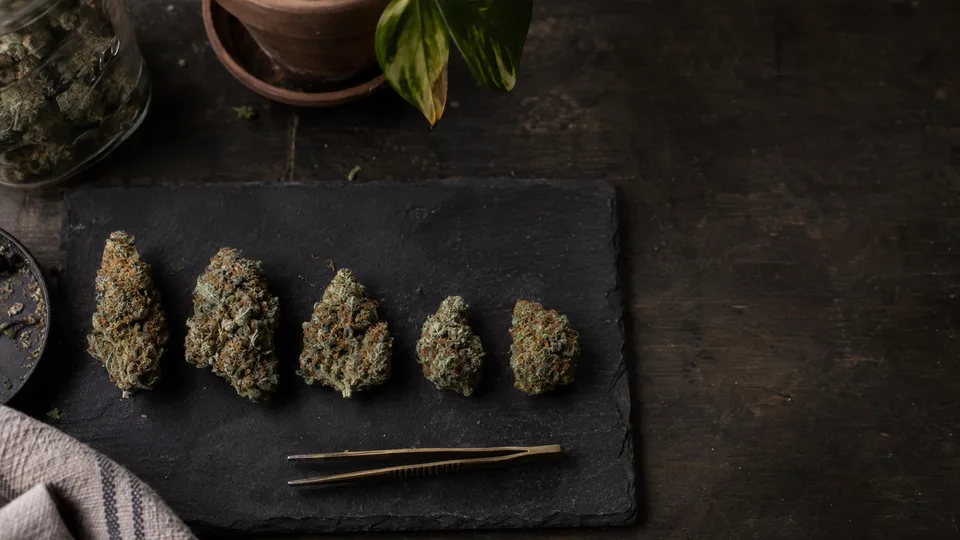
Dozens of breeders offer White Widow. None of them offer the same White Widow. What a strain name does and does not promise.
Search for White Widow and you will find it offered by dozens of breeders, at very different prices, with different THC figures, flowering times and yields. They cannot all be right about the same plant. They are not describing the same plant.
Understanding why is one of the most useful things anyone choosing seeds can learn, and it is the reason Seedsbay shows each breeder's figures separately on a seed page.
In short
- A strain name is not protected or standardized. Anyone can release a "White Widow".
- Each breeder works from their own parent plants, so their version is their interpretation of the strain.
- Even within one pack, seeds are siblings, not clones. The visible differences between them are called phenotypes.
- Well-bred lines keep those differences small. That consistency is what you are paying a good breeder for.
A name is not a recipe
In most of the plant world, a variety name is tied to a registered, tested and protected variety. A Honeycrisp apple is a Honeycrisp because every tree is a graft from the same original.
Cannabis developed largely without registration, for legal reasons, and its naming never got that structure. When a strain becomes famous, other breeders release their own. Some obtained a cutting of the original plant and bred from it. Some crossed similar parents to recreate it. Some selected a plant that resembles it from a related line. And a few simply put a famous name on something else.
All of these can end up on the market under the same name.
Seeds are siblings, not copies
When you take a cutting from a plant, the cutting is genetically identical to it. That is a clone.
A seed is different. It is the offspring of two parents, and like children in a family, each seed inherits a different combination of their traits. Plant ten seeds of the same strain and you will see ten related plants: a taller one, a more compact one, one that smells more of citrus, one that finishes a week earlier.
Each of those observable versions is called a phenotype. The underlying genetic make-up is the genotype, and the environment you grow in also shapes how it is expressed.
How much variation you get depends on how the breeder worked:
| Line type | What it means | Variation between plants |
|---|---|---|
| IBL (inbred line) | Bred within itself for many generations | Very low |
| Stabilized hybrid, F4 and beyond | Selected over several generations | Low |
| True F1 from inbred parents | First cross of two uniform lines | Very low, with extra vigor |
| F1 from two hybrid parents (polyhybrid) | First cross of two already-mixed plants | Moderate to high |
| F2 | Offspring of two F1 plants | High: the widest spread of traits |
Most modern strains are polyhybrids. That is not a flaw. It is where new and exciting plants come from. But it explains why two seeds from the same pack of a new release can grow quite differently, while ten seeds of a decades-old line like Skunk #1 look like a row of twins.
What differs between breeders
The parent plants. This is the main difference. A breeder who has held and refined a selected mother for years offers something different from one who ordered a pack and made seeds from it.
The goal of selection. One breeder may select their version for yield, another for flavor, another for short flowering time or mold resistance. Same name, different priorities.
Stability. How many generations of selection went into the line decides how uniform your plants will be.
Seed production quality. Maturity of the seeds at harvest, storage conditions and how fresh the stock is all affect germination rates.
How figures are reported. Some breeders publish cautious averages. Some publish the best result they ever saw.
How to choose which version to grow
- Look for the originator. If the breeder who created or popularized the strain still offers it, their version is the reference. Strain pages on Seedsbay list lineage and, where known, the original breeder.
- Compare the figures side by side. On a seed type page you see each breeder's THC, flowering time and yield for the same strain. Look for the group that broadly agrees. Be cautious of a version whose figures are far above everyone else's.
- Read the description for how the line was made. Words like "stabilized", "selected over several generations" or "from the original cut" are good signs. A description that says nothing about origin tells you something too.
- Decide how much uniformity you need. For a small personal grow, some variation is harmless and can be fun. For many plants under one light, uniform height and finishing time matter, and a stable line or a true F1 hybrid is worth more.
- Then compare price. A version at half the price per seed is not a better deal if it is a different plant. Among versions you trust, price per seed is a fair tie-breaker.
The labels that mean "different plant"
Fast, F1, CBD, XXL, Auto: each of these signals a different cross or selection, not a variant of the same seed. Seedsbay lists Fast, F1, CBD and XXL versions as separate strains linked to the original, and lists the autoflower as its own seed type with its own figures, precisely so that like is compared with like.
If you find a plant you love
Because seeds vary, the only way to grow that exact plant again is to keep it alive. Take cuttings before you switch to flowering, label them, and keep the cutting from your favorite plant as a mother. This only works with photoperiod plants. Autoflowers cannot be kept this way, which is why breeder consistency matters even more when you choose autoflower seeds.
Frequently asked questions
Is the most expensive version the most authentic?
Not necessarily. Price reflects reputation, marketing and pack size as well as breeding work. Lineage and consistency of figures are better guides.
Why did my plants from one pack look different from each other?
That is normal phenotype variation. It is greater in newer polyhybrid strains and smaller in old, stabilized lines.
Are "clone-only" strains available as seed?
A clone-only strain exists as one specific plant, shared by cuttings. Seeds sold under its name are crosses made with that plant or attempts to recreate it, so expect a family resemblance and not a copy.
What is a phenotype?
The observable version of a plant: its height, shape, smell, flowering time and so on. Seeds from one pack are siblings, so each shows a slightly different phenotype of the same strain.
How do I find the original breeder of a strain?
Strain pages on Seedsbay list lineage and, where known, the original breeder. A breeder that has carried the strain for many years and describes how the line was made is usually the reference.
Can I compare prices between different breeders' versions?
First decide which breeder's version you want, because they are different plants. Then compare that breeder's seeds across shops on price per seed.
Next step
Pick a classic strain and open its feminized seed page. Look at how many breeders offer it and how their figures compare. It is the quickest way to see how much a name can hide.
Ready to compare prices?
Compare every seed type by price per seed across seedshops.