
The method behind seedless watermelons has reached cannabis. What a triploid is, which benefits are solid, and which are still claims.
A seedless watermelon is a triploid: a plant with three sets of chromosomes instead of two, which cannot make viable seed. Bananas and many seedless grapes work the same way. In the last few years breeders have brought the method to cannabis. Triploid seeds are still rare and cost more than ordinary ones, and they come with a mix of solid benefits and bold claims that are worth telling apart.
In short
- Normal cannabis has two sets of chromosomes. A triploid has three.
- Triploids set almost no seed, even when pollen reaches them.
- That is the well-supported benefit. Claims about extra vigor, yield and potency come mainly from breeders.
- They suit growers at risk of stray pollen. For a sealed indoor grow the advantage is small.
Two, four, three
Every cell of a normal cannabis plant holds two sets of chromosomes, one from each parent. Such a plant is called diploid.
| Plant | Sets of chromosomes | How it comes about |
|---|---|---|
| Diploid | 2 | Every ordinary cannabis plant |
| Tetraploid | 4 | A diploid whose chromosome count has been doubled by treatment |
| Triploid | 3 | The offspring of a tetraploid and a diploid |
To make triploid seeds, a breeder first creates a tetraploid line by treating young plants with a compound that interferes with cell division, so that the chromosomes double and stay doubled. That line is grown on, checked and stabilized. It is then crossed with an ordinary diploid plant. The offspring receive two sets from one parent and one set from the other: three in all.
No genes are inserted or edited. It is the same technique that plant breeders have used on fruit and flowers for almost a century.
Why three sets make a plant seedless
To make seed, a plant has to divide its chromosomes into two equal halves. With two sets or four that works. With three it does not: the sets cannot be shared out evenly, and most of the resulting cells are not viable.
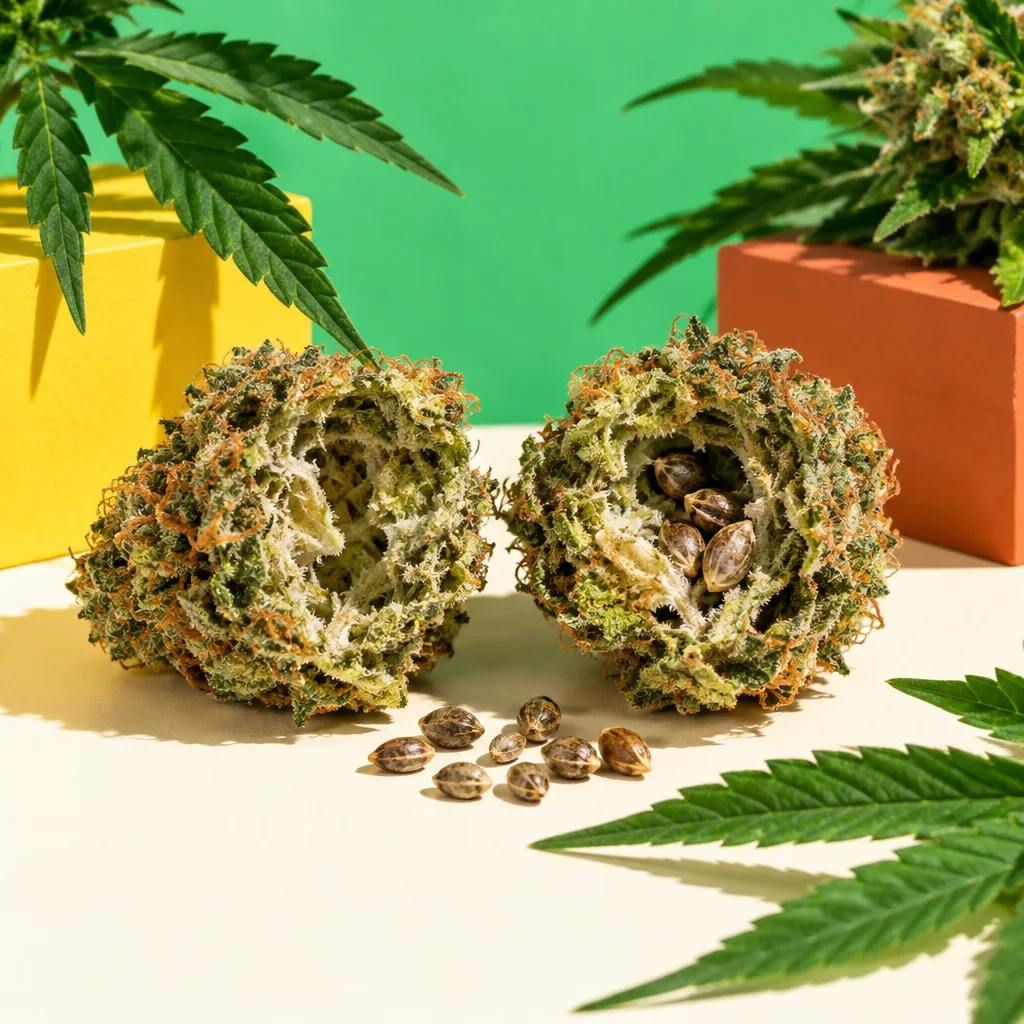
A triploid female still flowers normally. If pollen lands on her, very few seeds form. Breeders describe a reduction of well over ninety percent compared with a normal plant in the same conditions.
Why that matters
A pollinated female puts her energy into seeds. Resin production falls, the flowers are lighter in what growers want, and every seed has to be picked out. For most indoor growers pollen is not a concern. For some growers it is the main risk of the season:
- Outdoors, within reach of other cannabis or hemp. Pollen travels far on the wind.
- Next to a breeding project, where males flower in the same building.
- In a room where one plant turns hermaphrodite. A triploid crop shrugs off what would seed a diploid one.
For these growers, a plant that ignores pollen is worth a higher seed price.
What is solid and what is claimed
| Benefit | Status |
|---|---|
| Far fewer seeds when pollinated | Well supported. It follows directly from the genetics |
| Sterile, so the line cannot be reproduced from its seeds | Certain |
| More vigor and larger plants | Reported by breeders for some lines. Not consistent across all |
| Higher yield | Reported by breeders. Independent comparisons are limited |
| Higher potency or terpene content | Reported by breeders. Evidence is thin and mixed |
Extra sets of chromosomes often give larger cells and sturdier plants in other crops, so the claims are plausible. They are also specific to each line. Treat seedlessness as the reason to choose a triploid, and anything else as a possible bonus to verify in your own grow.
What to check on a seed page
- Does the breeder state that the line is triploid, and how it was made?
- Are figures given for the triploid line itself, or borrowed from the ordinary version of the strain?
- How do the figures compare with the same breeder's ordinary lines?
- What is the price per seed, and how much is the premium?
- Is it feminized? Almost all triploid seeds on offer are.
A pack that says "triploid" without explanation deserves the same caution as any unexplained label.
In the garden
Triploids grow like other cannabis of their type. A few points growers report:
- Germination can be slightly slower or less even than with ordinary seeds.
- Vigor in growth is often good. Plants can end up larger than expected, so watch the height.
- Flowering time is in the normal range for the strain.
- Hermaphrodites. A triploid can still form male flowers under stress. The pollen is mostly not viable, which limits the damage.
- No seeds to save. If you find a plant you love, keep it as cuttings. Photoperiod triploids can be kept as mothers like any other plant.
Triploids and F1 hybrids
The two are sometimes mentioned together, and they solve different problems.
| True F1 hybrid | Triploid | |
|---|---|---|
| Main benefit | Uniform, vigorous plants | Seedless flowers when pollen is present |
| How | Two inbred parent lines | A tetraploid crossed with a diploid |
| Seed from the plants | Possible, but varies widely | Practically none |
| Price | Above standard | Above standard |
A line can be both. Read the description to see which benefit a breeder is offering.
Who should consider them
| You are | Triploids are |
|---|---|
| Growing outdoors where pollen may arrive | Worth the premium |
| Running a breeding project and a harvest under one roof | Worth considering |
| Growing indoors in a sealed tent | A curiosity. Ordinary seeds do the same job |
| Wanting to make your own seeds | The wrong choice |
| On a first grow | Unnecessary |
On Seedsbay
Where breeders offer triploid lines, they are listed as strains of their own, with the breeder's figures on the seed page. Compare those figures with the same breeder's ordinary lines, and compare the price per seed across shops. Because few breeders make triploids so far, the description of how the line was produced is the most useful thing on the shop's page.
Frequently asked questions
What does triploid mean?
A plant with three sets of chromosomes instead of the usual two.
Are triploid seeds genetically modified?
No genes are added. A parent line has its chromosome count doubled by treatment, and is then crossed conventionally with a normal plant.
Are triploid plants completely seedless?
Nearly. They set very few seeds when exposed to pollen. Breeders describe reductions of well over 90%, not zero.
Do triploids yield more?
Breeders report that some do. Independent comparisons are still limited, and results differ by line.
Can I make seeds from a triploid plant?
Not in practice. They are largely sterile, which is the point.
Who needs seedless plants?
Growers whose plants may be reached by pollen: outdoors near other growers or hemp fields, or indoors alongside a breeding project.
Next step
Ask whether pollen is a real risk where you grow. If it is, look at how a triploid line is described and what it costs per seed. If it is not, an ordinary feminized line gives you the same seedless harvest.
Ready to compare prices?
Compare every seed type by price per seed across seedshops.