
Behind ten seeds in a sealed tin sit years of growing, selecting and discarding plants. What that work involves, and how to recognize it from the outside.
A seed pack is the end of a long process. Behind ten seeds in a sealed tin sit years of growing, selecting and discarding plants. Knowing what that work involves explains why two packs with the same strain name can differ in price, in consistency and in what comes up when you plant them.
In short
- Breeding is selection: growing many plants in order to keep very few.
- A new line takes from one year to more than five, depending on how stable it needs to be.
- Seed production is a craft of its own: pollination, ripening, cleaning, testing and cold storage.
- The signs of careful work are visible to you: a clear lineage, consistent figures, batch codes and steady germination.
The steps
| Step | What happens | Typical time |
|---|---|---|
| 1. Set a goal | Decide what the line should do: finish early, taste of citrus, stay short | Before anything is grown |
| 2. Find parents | Grow out dozens to hundreds of seeds or collect proven cuttings | 4 to 8 months per round |
| 3. Select | Keep the few best plants as cuttings, discard the rest | Part of step 2 |
| 4. Test crosses | Cross candidates and grow the offspring to judge the parents | 4 to 6 months per cross |
| 5. Stabilize | Select and cross again over several generations, or fix two parents for an F1 | 4 to 6 months per generation |
| 6. Produce seed | Pollinate selected females in an isolated room and let seeds ripen | 3 to 4 months |
| 7. Clean and test | Dry, sieve, sort and test germination per batch | Weeks |
| 8. Store and pack | Keep cold and dry, pack sealed with a batch code | Until the batch is sold |
Selection is the real work
A cross takes an afternoon. Deciding which plants deserve to be crossed takes seasons.
From a hundred seeds, a careful breeder may keep two or three. Each plant is judged on vigor, structure, flowering time, resin, aroma and resistance to pests and mold. Cuttings are taken from every candidate before flowering, because by the time the flowers can be judged the plant itself is finished.
Then comes the test that matters most. A plant that looks excellent does not always pass its traits on. So breeders cross their candidates and grow the offspring. A parent is kept for what its seeds do, not for what it looks like.
Good breeders also try to break their candidates. They interrupt the dark period, let the room run hot or leave plants past ripeness. Any plant that responds by growing male flowers is discarded, because its seeds would do the same in your tent.
Stabilizing, or not
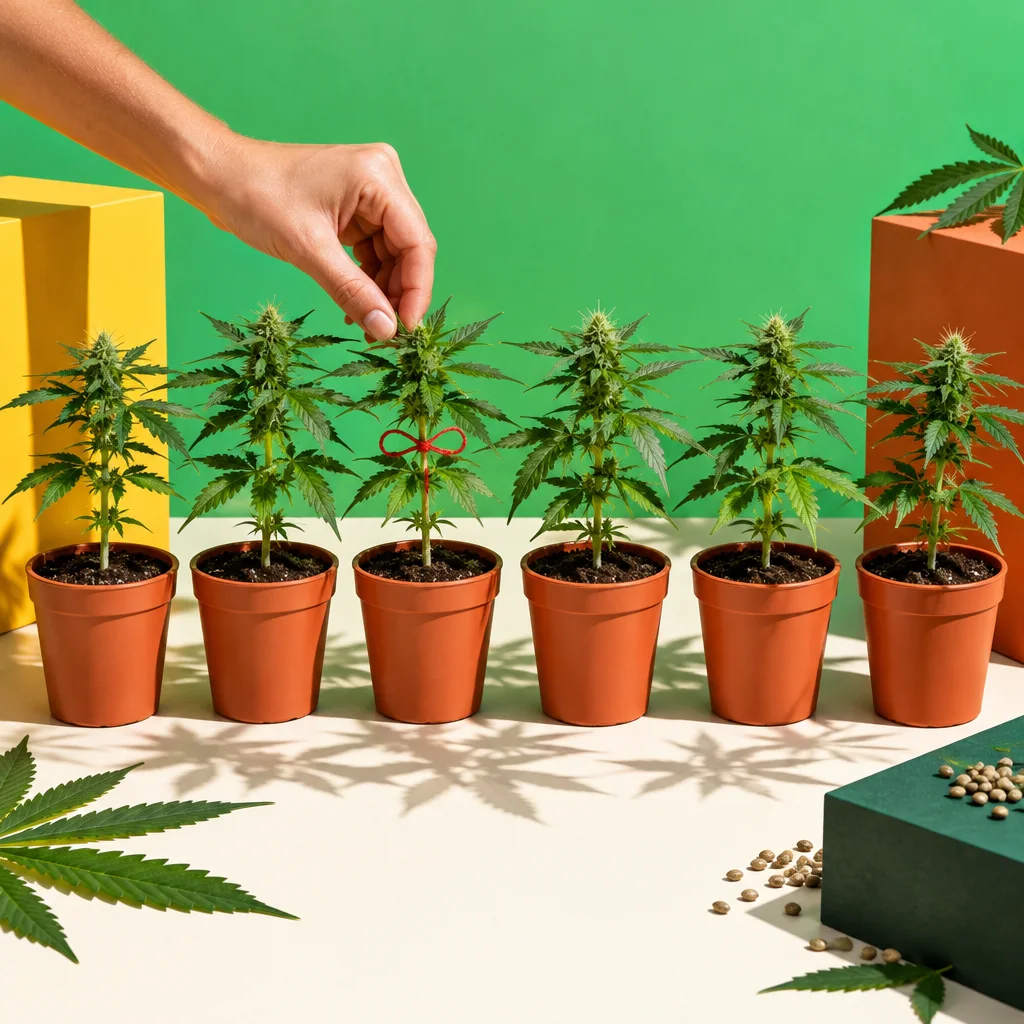
Once the parents are chosen, a breeder has two routes.
Work the line. Grow the seeds, select the best, cross them, repeat. Each generation makes the plants more alike. After four or five generations the line gives uniform plants. This takes years.
Fix the parents. Keep one proven mother and one proven father alive as cuttings, and make the same cross again for every batch. The seeds are first-generation every time. How uniform they are depends on how uniform the parents' own lines were.
Most strains on the market are made the second way. It is faster, and it is why keeping parent plants alive matters so much: if the mother is lost, the strain as it was is gone.
Making the seeds
Seed production happens in a separate, sealed room, because one stray grain of pollen in the wrong place ruins a batch.
- Regular seeds: pollen from the selected male is applied to the selected females.
- Feminized seeds: a branch or a clone of a female is treated so that it makes pollen, and that pollen is used on other females. No male is involved, so the seeds give female plants.
After pollination the seeds need four to six weeks to ripen on the plant. Harvesting them early gives pale, soft seeds that germinate poorly.

Cleaning, testing, storing
Ripe seed heads are dried and threshed, and the seeds are separated from the chaff with sieves. Small, pale and cracked seeds are sorted out.
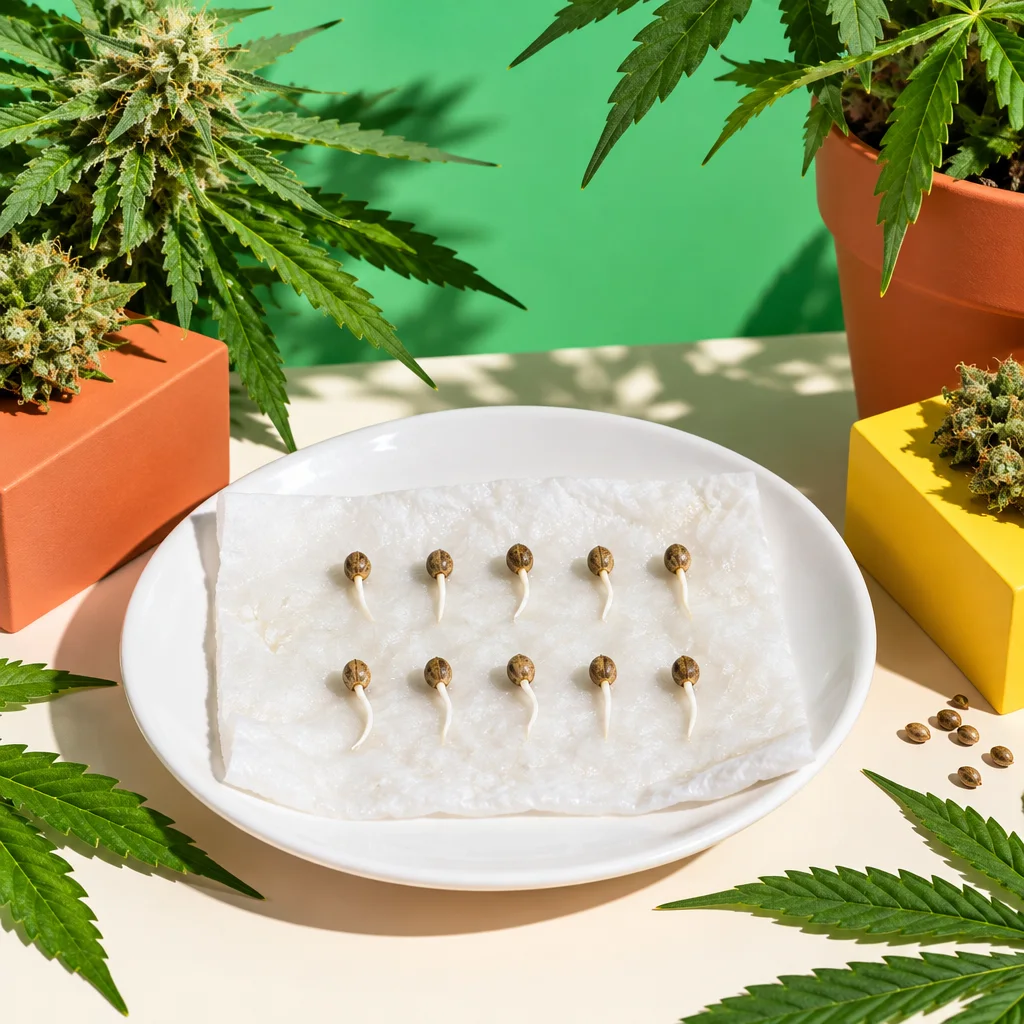
Then a sample from the batch is germinated. A batch that falls short is not sold by a serious breeder. Seeds that pass are stored cold and dry, and packed in sealed, crush-proof packaging with a batch or date code.
Careful work and quick work
| Careful | Quick | |
|---|---|---|
| Plants selected from | A hundred or more | One pack |
| Parents tested through their offspring | Yes | No |
| Stress-tested for male flowers | Yes | No |
| Same parents kept for every batch | Yes | New parents when convenient |
| Germination tested per batch | Yes | Not stated |
| Batch code on the pack | Yes | No |
Both kinds of seeds reach the market under the same strain names. The pack price does not always tell them apart.
What you can see from the outside
- The description. Does it say where the parents came from and how the line was made?
- The figures. Realistic ranges suggest measurement. Record-breaking single numbers suggest marketing.
- Consistency over time. A strain that has been in a breeder's catalog for ten years with steady reviews comes from parents that are still alive.
- The pack. Sealed original packaging with a batch code.
On Seedsbay
Every offer is grouped by breeder, because the breeder defines what is in the pack. On a seed page, each breeder's flowering time, yield and THC stand side by side, so you can see who agrees with whom. Breeder pages list the strains a breeder offers and the shops that carry them.
Frequently asked questions
How long does it take to create a strain?
A simple cross of two proven parents can be on the market within a year. A stable line that gives uniform plants takes three to five years or more.
Why are some breeders' seeds more expensive?
Selection work, keeping parent plants alive, testing and reputation all cost money. A higher price does not guarantee better seeds, but careful work is rarely the lowest-priced.
Do breeders grow the seeds themselves?
Many do. Others use contract producers who work with the breeder's own parent plants.
What is a mother plant?
A selected female kept in the growth stage under long days, so cuttings can be taken from it for years. The equivalent male is kept the same way.
How do breeders test for hermaphrodites?
They stress candidate parents on purpose, for example with interrupted dark periods, and discard any plant that grows male flowers.
Why does a strain sometimes change over the years?
If a breeder loses a parent plant or selects new ones, later batches come from different genetics. Batch codes on the pack help you tell them apart.
Next step
Pick a classic strain and open its seed page. Read two or three breeders' descriptions on the shop's page and note which ones explain their parent plants and selection. Then compare their figures.
Ready to compare prices?
Compare every seed type by price per seed across seedshops.