
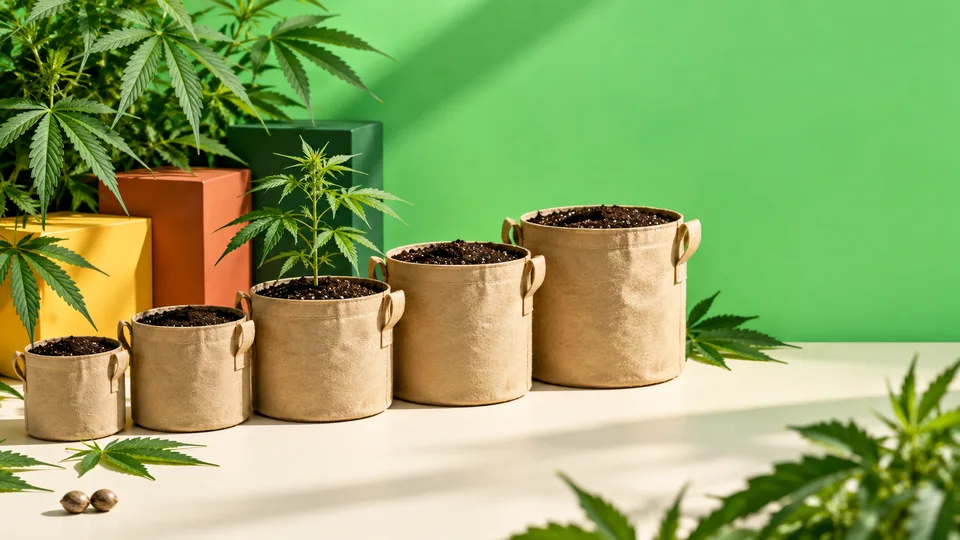
The pot decides how big a plant can get and how often you water. Which size for which seed type, and when to move up.
A pot does two jobs. It sets an upper limit on how large the plant can grow, and it decides how often you have to water. The right size depends on the seed type, because autoflowers and photoperiod plants use their pots very differently.
In short
- Autoflowers: 11 to 19 liters, from the day you sow.
- Photoperiod indoors: start small, pot up once or twice, and finish in 19 to 26 liters.
- Photoperiod outdoors: 38 liters and up.
- Rule of thumb: 1 to 2 gallons of pot per foot of final plant height.
Final pot sizes
| Plant | Final pot | Typical fabric pot width |
|---|---|---|
| Many small plants, flowered early | 8 to 11 liters | 23 to 25 cm |
| Compact autoflower | 11 liters | 25 cm |
| Larger autoflower | 19 liters | 30 cm |
| Trained photoperiod plant, indoors | 19 to 26 liters | 30 to 35 cm |
| One large photoperiod plant, indoors | 38 liters | 40 cm |
| Photoperiod plant, outdoors in a pot | 38 to 95 liters | 40 to 53 cm |
Check the widths against your floor space before you choose. Four 7 gallon pots fit a 4 x 4 ft tent comfortably. Four 10 gallon pots leave little room to work.
The rule of thumb
Allow 1 to 2 gallons of pot for each foot of final plant height, which is roughly 12 to 25 liters per meter.
| Final plant height | Pot |
|---|---|
| 60 cm | 8 to 15 liters |
| 90 cm | 11 to 23 liters |
| 120 cm | 15 to 30 liters |
| 180 cm | 23 to 45 liters |
Use the lower end if you can water daily, the upper end if you want a few days between waterings.
Autoflowers: one pot, start to finish
An autoflower begins to flower at three to five weeks old, whatever its size. A transplant that stalls the roots for a week costs growth the plant cannot make up. So the standard advice is to sow in the final pot.
The drawback is a tiny seedling in a large volume of soil. Handle it by watering only a small ring around the stem and widening the ring as the plant grows.
Pot size is also the simplest way to steer the size of an autoflower. The same seed in a 2 gallon pot stays markedly smaller than in a 5 gallon pot.
Photoperiod plants: potting up
Because you choose when flowering starts, a few days of recovery after transplanting cost nothing. That makes stepping up through pot sizes the better method:
| Stage | Pot |
|---|---|
| Seedling, weeks 1 to 2 | 0.5 liter |
| Growth, weeks 3 to 5 | 4 liters |
| Before the switch to 12-12 | 19 to 26 liters |
Each step is easy to water correctly, and each builds a dense root ball that fills the next pot quickly. Do the last transplant one to two weeks before the switch, so the roots are established when flowering begins.
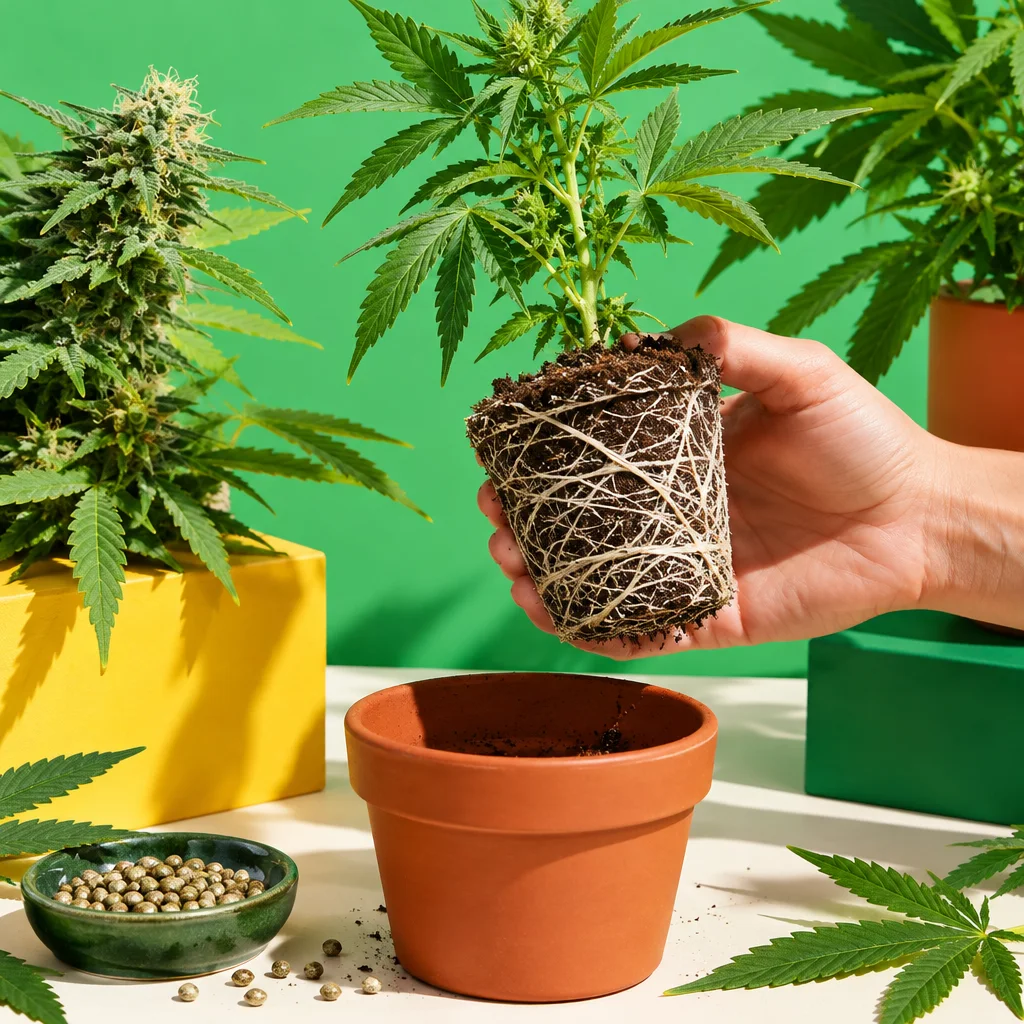
When to pot up
- Leaves reach past the rim of the pot.
- Roots show at the drainage holes or circle the outside of the root ball.
- The pot dries out within a day.
- Growth slows although light and feeding are right.
To transplant, water the plant the day before, slide the root ball out in one piece, set it in the new pot at the same depth or slightly deeper, and water it in.
Regular seeds
Start regular seeds in small pots and keep them there until they show their sex. There is no reason to fill large pots for plants you will remove. Pot up the females once they are identified.
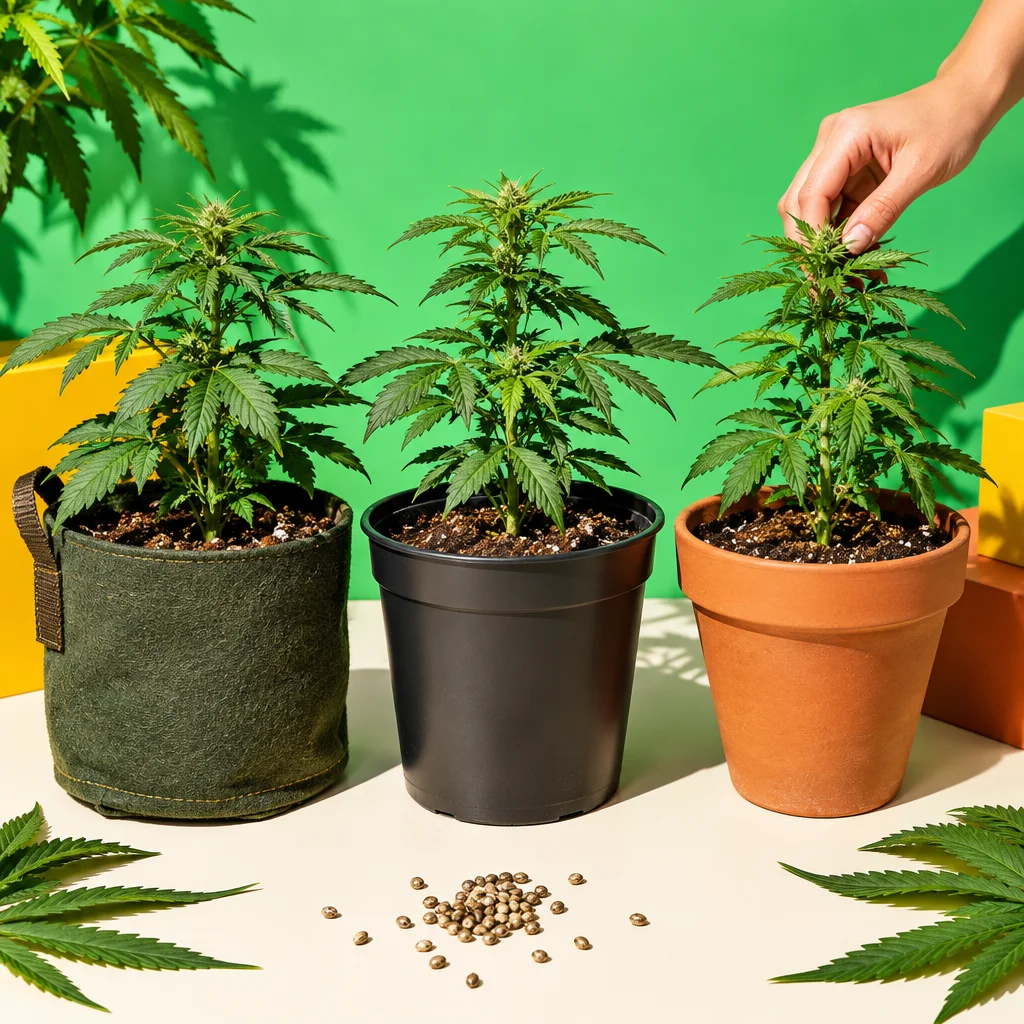
Pot types
| Type | For | Against |
|---|---|---|
| Fabric | Air reaches the roots. Hard to overwater. Roots branch instead of circling | Dries out fast. Needs a saucer |
| Plastic | Holds water longer. Low cost. Easy to slide a root ball out | Roots circle. Easier to overwater. Heats up in sun |
| Air pot | Similar to fabric, with rigid sides | Dries out fast. Bulky |
| Terracotta | Stable and cool | Heavy. Dries quickly through the walls |
For most home grows, fabric pots are the safe choice. Outdoors in hot sun, choose a light color.
Pot size and watering
| Pot | Watering, at full size indoors |
|---|---|
| 11 liters | Every day or two |
| 19 liters | Every two to three days |
| 26 liters | Every three to four days |
| 38 liters | About twice a week |
Outdoors in summer sun, halve those intervals. If you are away for long weekends, a larger pot is the simplest insurance.
Growing in coco
In coco, plants are fed with every watering and watered far more often, sometimes daily. Smaller pots work well: 8 to 11 liters supports a plant that would need 5 gallons of soil.
What this means when you choose seeds
The height on a seed page assumes a pot that lets the plant reach it. If your space only allows small pots, plants will finish below the listed height and yield, and that can be exactly what you want in a low tent. If you want the listed figures, give the plant the root space to match.
Frequently asked questions
What pot size is best for autoflowers?
11 to 19 liters as the final pot, used from the day you sow.
Can a pot be too big?
For the harvest, no. For a seedling, yes: a small plant in a large pot of wet soil is easily overwatered. Water in a small ring until the plant grows into it.
How do I know a plant needs a bigger pot?
Roots circle the inside of the pot, the plant dries out within a day, and growth slows. Pot up before flowering.
Should I transplant during flowering?
Avoid it. Pot up for the last time one to two weeks before you switch photoperiod plants to 12-12.
Are fabric pots better than plastic?
They give healthier roots and are harder to overwater. They also dry out faster, so you water more often.
Does a bigger pot mean a bigger harvest?
Only if light and time allow the plant to use it. Indoors the light is usually the limit before the pot is.
Next step
Take the height figure of the strain you have in mind, apply the rule of thumb, and check that the pots that result fit your floor space, with room to reach each plant.
Ready to compare prices?
Compare every seed type by price per seed across seedshops.