
The most used labels in cannabis are good at predicting plant shape and flowering time, and much less good at predicting effect.
"Indica for relaxing, sativa for energy." It is the first thing most people learn about cannabis, and it appears on every menu and most seed pages. It is also only half true.
The labels began as botanical descriptions of how plants look and where they come from. For that purpose they still work well, and for a grower they are useful. As a prediction of how the harvest will feel, they are much less dependable. Knowing which half to trust makes choosing seeds easier.
In short
- For growing, the label is a good guide: indica-leaning plants are shorter, bushier and faster; sativa-leaning plants are taller, airier and slower.
- For effect, the label is a rough hint at best. The cannabinoid and terpene content of the specific plant tells you far more.
- Nearly every modern strain is a hybrid. A percentage such as "70% indica" describes ancestry and growth pattern, not a measured property of the effect.
Where the words come from
Cannabis sativa was described in the 1700s from the tall, fibrous hemp plants grown in Europe. A few decades later, shorter, broad-leafed, resinous plants from the Indian subcontinent were described as Cannabis indica.
In the 1970s, travelers and breeders brought seeds home from two broad regions. From the mountains of Afghanistan and Pakistan came compact, fast, broad-leafed hash plants, which became "indicas" in growers' language. From equatorial regions such as Thailand, Colombia, Mexico and southern Africa came tall, slow, narrow-leafed plants, which became "sativas".
Those two plant types adapted to very different conditions, and their growth habits reflect that.
What the label reliably tells a grower
| Indica-leaning | Sativa-leaning | |
|---|---|---|
| Height | Short to medium | Tall |
| Shape | Bushy, tight spacing between branches | Open, long spacing between branches |
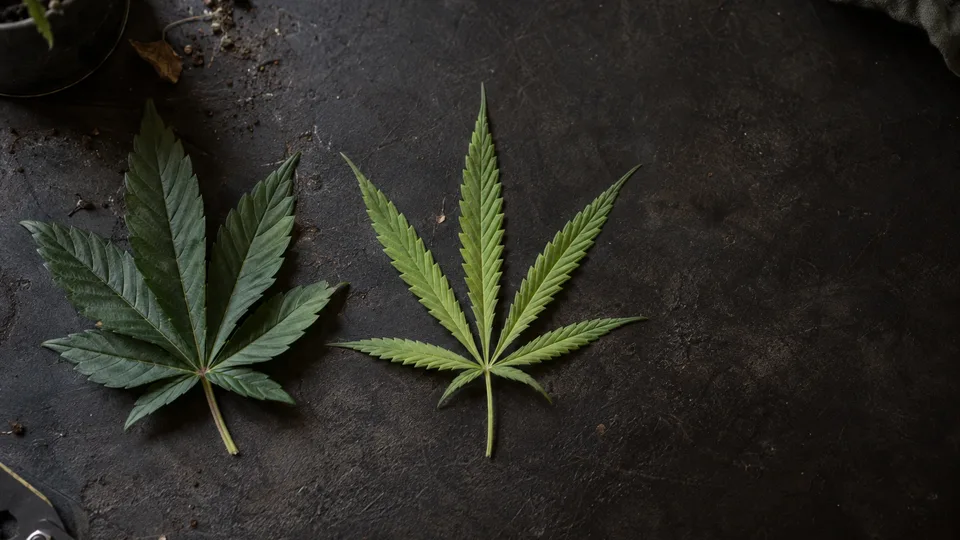
| Leaves | Broad fingers, dark green | Narrow fingers, lighter green |
| Stretch after flowering begins | About 1.5 times | 2 to 3 times |
| Flowering time | 7 to 9 weeks | 10 to 14 weeks |
| Flowers | Dense and compact | Longer, looser, sometimes foxtailed |
| Mold risk in humid air | Higher, because flowers are dense | Lower, because flowers are airy |
| Natural fit | Indoor, low spaces, short seasons | Outdoor in long warm seasons, tall rooms |
These differences come from the environments the plants adapted to. Mountain plants had to finish before an early, cold autumn. Equatorial plants had twelve-hour days all year and no reason to hurry, with airy flowers that cope with tropical humidity.
If your space is low or your season short, leaning indica is practical advice. If you have height and a long dry autumn, sativa-leaning strains become an option.
Why the label is weak at predicting effect
How cannabis feels depends on its chemistry: mainly the amounts of THC and CBD, shaped by the mix of aromatic compounds called terpenes. When researchers have analyzed large numbers of samples sold as indica or sativa, they have found that the labels do not sort cleanly into two chemical groups. Samples with the same label often differ more from each other than from samples with the opposite label.
There are three reasons for this.
Almost everything is a hybrid. After fifty years of crossing, truly pure lines are rare. A strain sold as a sativa may have a broad-leafed grandparent that contributed most of its chemistry.
Shape and chemistry are inherited separately. A plant can look like a textbook indica and carry the terpene profile of its sativa parent.
Labels are often assigned by look or by tradition. Sometimes by the effect someone expected. They are rarely assigned by measuring anything.
This does not mean the traditional association is pure myth. Sedating effects are often linked with the terpene myrcene, which is common in many Afghan-derived lines, and bright, citrus or pine terpene profiles are common in many equatorial lines. But it is the chemistry doing the work, and the label only sometimes travels with it.
So how should you choose for effect?
Use information that is closer to the cause:
- THC and CBD levels. These set the overall strength and how intense the experience is. A 1:1 THC to CBD strain feels very different from a high-THC strain, whatever its label.
- Dominant terpenes. These are the best available guide to the character of the effect and are fairly consistent within a strain.
- Reported effects. Descriptions gathered from many users of a strain, such as relaxed, uplifted, sleepy or focused, summarize real experience.
- Your own notes. People respond differently. If a strain suited you, look at what it contained and look for that profile again.
Seedsbay shows all four on a strain page, next to the indica to sativa ratio. Read the ratio for the grow and the rest for the harvest.
What does "hybrid" mean, then?
In practice, "hybrid" on a label means "somewhere in the middle", which describes most of the market. A ratio gives a little more detail:
- Indica-dominant hybrid (60 to 80% indica): grows like an indica with a bit more stretch.
- Balanced hybrid (around 50/50): medium height, medium flowering time, the easiest to fit into most spaces.
- Sativa-dominant hybrid (60 to 80% sativa): noticeably taller, flowering nearer ten to eleven weeks. Many have been bred to finish faster than pure sativas, which makes them the practical way to get that kind of plant indoors.
And ruderalis? It is the third type, responsible for the autoflowering trait. It rarely appears in the ratio because breeders select it down to the minimum needed for autoflowering.
Frequently asked questions
Will an indica always make me sleepy?
No. Many will, because many share a similar chemical profile, but the label does not guarantee it. Check terpenes and reported effects.
Are sativas harder to grow?
Pure and near-pure sativas are: they are tall, slow and need patience. Sativa-dominant hybrids bred for indoor growing are much more manageable.
Are the percentages on a seed page measured?
No. They are the breeder's estimate based on parentage and how the plant grows. Treat "70% indica" as a description of growth habit.
What does "70% indica" mean on a seed page?
It is the breeder's estimate of the strain's ancestry and growth habit. It is not a measured property, and it says more about plant shape and flowering time than about effect.
Is indica or sativa better for a small tent?
Indica-leaning and balanced hybrids. They stay shorter and stretch to about one and a half times their size after flowering starts, where sativa-leaning plants can double or triple.
Do indicas yield more than sativas?
Indoors, indica-leaning strains often produce more per week of flowering, because they finish faster. Outdoors in a long, warm season, large sativa-leaning plants can yield very heavily.
Next step
Compare indica and sativa listings, then read the specific breeder's figures and description. A category label alone does not establish an individual plant's characteristics or effects.
Ready to compare prices?
Compare every seed type by price per seed across seedshops.