
The seed type you choose decides how you run your light. One difference sets your timer, your power use and how forgiving the grow is.
The seed type you choose decides how you run your light. Photoperiod plants, grown from feminized or regular seeds, take their cue from the length of the night. Autoflowers ignore it. That one difference sets your timer, your power use and how forgiving the grow is.
In short
- Photoperiod: 18 hours of light to grow, then 12 hours of light and 12 of unbroken darkness to flower.
- Autoflower: 18 to 20 hours of light from sprout to harvest. No switch.
- Darkness has to be truly dark for photoperiod plants. Light leaks cause real problems.
- Power use per run is often similar. The autoflower run is shorter, and the photoperiod run yields more.
The schedules
| Stage | Photoperiod (feminized, regular) | Autoflower |
|---|---|---|
| Seedling | 18-6 | 18-6 |
| Growth | 18-6 | 18-6 or 20-4 |
| Flowering | 12-12 | 18-6 or 20-4 |
| What starts flowering | You, by switching the timer | The plant, at 3 to 5 weeks old |
The first number is hours of light, the second hours of darkness.
Why photoperiod plants need long nights
A photoperiod plant measures the length of uninterrupted darkness. While nights are short it keeps making leaves and branches. Once nights stay long, about 12 hours indoors, it reads that as autumn and starts to flower.
This gives you the control that makes photoperiod growing attractive. The plant stays in growth for as long as you keep the days long. Four weeks gives a small plant, eight a large one. A plant that had a setback can simply be given more time.
The price is discipline in the dark period.
Light leaks
During flowering, the 12 hours of darkness must not be interrupted. A gap in a tent zipper, an indicator light on a power strip or a door opened at night can be enough to confuse the plant. The results range from slower flowering, to a plant drifting back toward leaf growth, to female plants forming pollen sacs.
Check it once. Sit inside the closed tent, or stand in the dark room, with the lamp off for a few minutes. If you can see your hand, find the leak and tape it.
Outdoors the same rule applies to street lights, porch lights and windows that shine on plants at night.
Autoflowers are not affected by any of this.
Autoflowers: one setting, start to finish
Because an autoflower flowers by age, it can have long days all the way. More light hours mean more growth per day, which matters in a life of ten weeks.
- 18-6 is the standard. Six hours of darkness lets the room cool and costs less.
- 20-4 gives a little more growth for a little more power.
- 24-0 works, but most growers see no gain over 20-4 that justifies the cost.
- 12-12 also works, which is useful when autoflowers share a tent with flowering photoperiod plants. Expect smaller plants and a lighter harvest.
What it means for the power bill
Take a 200 watt LED.
| Photoperiod run | Autoflower run | |
|---|---|---|
| Growth | 5 weeks at 18 hours a day | Included below |
| Flowering | 9 weeks at 12 hours a day | Included below |
| Whole run | 14 weeks | 11 weeks at 18 hours a day |
| Lamp hours | 1,386 | 1,386 |
| Electricity | about 277 kWh | about 277 kWh |
In this example the two runs use the same electricity. The autoflower is finished three weeks sooner. The photoperiod plants had longer to grow and will usually carry more flower.
Multiply the kWh by your own rate to see the cost, and adjust the weeks to the strain. The flowering time on the seed page is the figure that moves the total most.
Sharing one tent
Autoflowers and photoperiod plants can grow together while the timer is on 18-6. After the switch to 12-12, autoflowers keep flowering, but with a third less light per day. If you want both, start the autoflowers so that they finish around the time you switch.
Outdoors
The sun sets the schedule. Photoperiod plants grow through the long days of early summer and begin to flower some weeks after midsummer, as nights lengthen. The further from the equator you are, the later that happens and the later the harvest.
Autoflowers can be sown at any point in the warm season and take about ten weeks, whatever the day length.
Timers
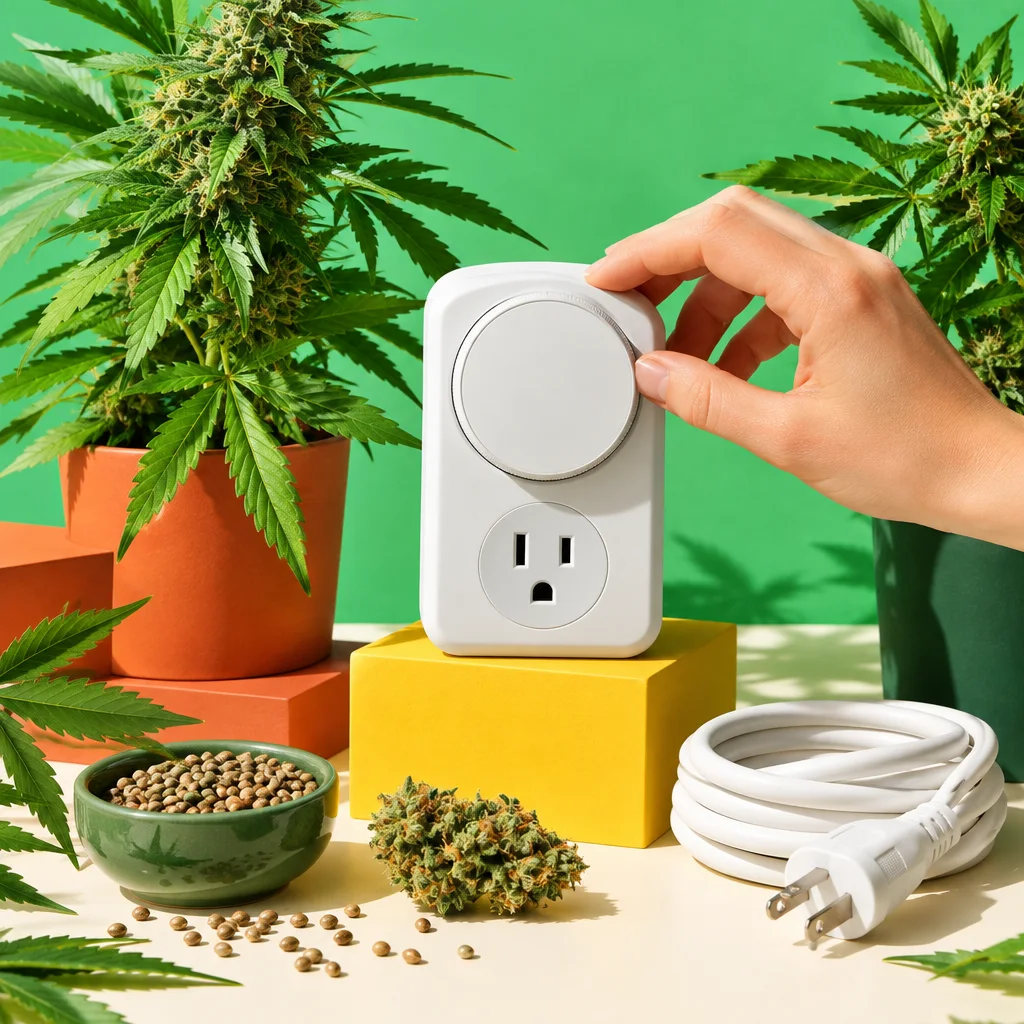
A timer is the least expensive part of a grow and one of the most important. A mechanical plug-in timer is enough. Check that it is rated for the wattage of your lamp, set it once, and test it over a full day before plants depend on it. For photoperiod plants, keep the dark period at the same clock hours every day.
On Seedsbay
The seed type on each page tells you which schedule applies. For feminized and regular seeds, the flowering time shown counts from the switch to 12-12. For autoflowers, the figure is seed to harvest under long days.
Frequently asked questions
Can I flower photoperiod plants with less than 12 hours of darkness?
Most need about 12 hours of unbroken darkness to flower reliably. Some start with slightly less, but 12-12 is the safe standard.
Do autoflowers need darkness at all?
They grow without it. Most growers still give four to six hours, which saves power and lets the room cool.
What happens if my timer fails during flowering?
One disturbed night rarely does harm. Several days of irregular light can stress photoperiod plants. Reset the schedule and watch for pollen sacs over the next two weeks.
Does a longer growth phase change the flowering time?
No. Flowering time is counted from the switch and is set mainly by genetics. A longer growth phase makes a bigger plant.
Is 20-4 better than 18-6 for autoflowers?
It gives slightly more growth for slightly more power. The difference is small, and either works well.
Can I use a green light to work during the dark period?
Dim green light disturbs plants least, but brief and rarely is still the rule. It is better to plan work for the light hours.
Next step
Check the seed type of the strain you chose and write down your timer plan before the seeds arrive: one setting for autoflowers, two for photoperiod plants.
Ready to compare prices?
Compare every seed type by price per seed across seedshops.