
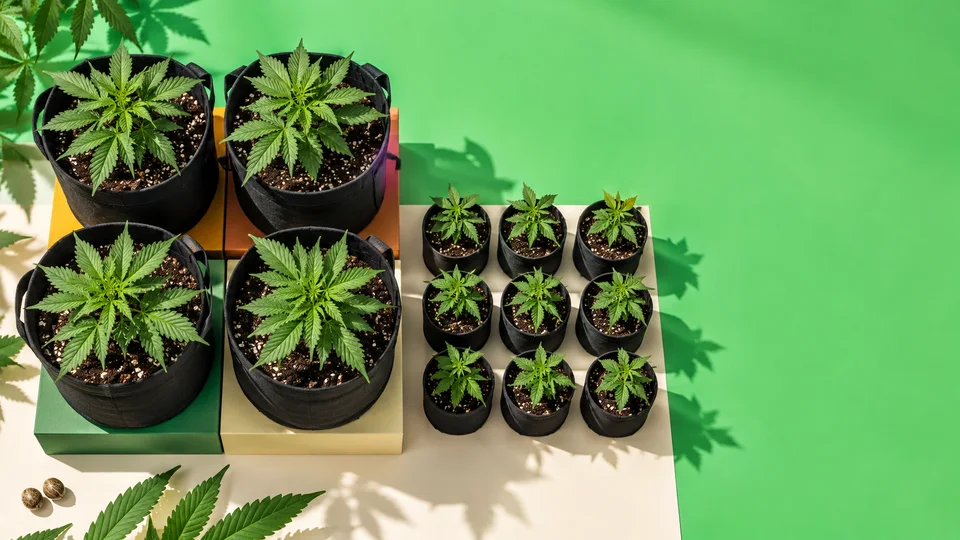
A light covers an area, not a number of plants. How many to run in each tent size, and what the choice changes about your grow.
How many plants to grow is one of the first decisions and one of the most misunderstood. A light covers an area. Fill that area with an even layer of flowering tops and the harvest is similar whether it comes from one plant or from nine. What the number of plants changes is how long the grow takes, how much work it is and how many seeds you need.
In short
- The harvest depends on the light and a full canopy, not on the plant count.
- Fewer plants need a longer growth phase and more training. More plants fill the space faster and need more seeds and more watering.
- Autoflowers cannot be grown bigger to fill a gap, so you run more of them.
- For most home tents, two to four trained photoperiod plants or four to six autoflowers is the practical range.
Plants per tent
| Tent | Area | Photoperiod, trained | Photoperiod, untrained | Autoflowers |
|---|---|---|---|---|
| 60 x 60 cm | 4 sq ft | 1 | 1 to 2 | 1 to 2 |
| 60 x 120 cm | 8 sq ft | 2 | 3 to 4 | 2 to 4 |
| 90 x 90 cm | 9 sq ft | 1 to 2 | 4 | 3 to 4 |
| 120 x 120 cm | 16 sq ft | 2 to 4 | 6 to 9 | 4 to 6 |
| 150 x 150 cm | 25 sq ft | 4 to 6 | 9 to 12 | 6 to 9 |
"Trained" means topped and spread out, usually under a net. "Untrained" means left to grow as a single main cola with side branches.
Why the count matters less than you think
A lamp delivers a fixed amount of light to a fixed area. Plants turn that light into flowers. Once the whole area is covered by leaves at an even height, adding plants adds nothing, because there is no more light to catch.
So the real choice is how to reach a full canopy:
| Approach | Growth phase | Work | Seeds |
|---|---|---|---|
| One large trained plant | 8 to 10 weeks | Much training, one pot to water | 1 plus a spare |
| Four trained plants | 4 to 6 weeks | Moderate | 4 plus a spare |
| Nine untrained plants | 3 to 4 weeks | Little training, nine pots to water | 9 plus one or two spares |
| Sixteen small plants, flowered early | 1 to 2 weeks | Almost no training, many pots | 16 or more |
The table is for a 4 x 4 ft tent. The pattern is the same in any size: time and training on one side, plant count on the other.
By seed type
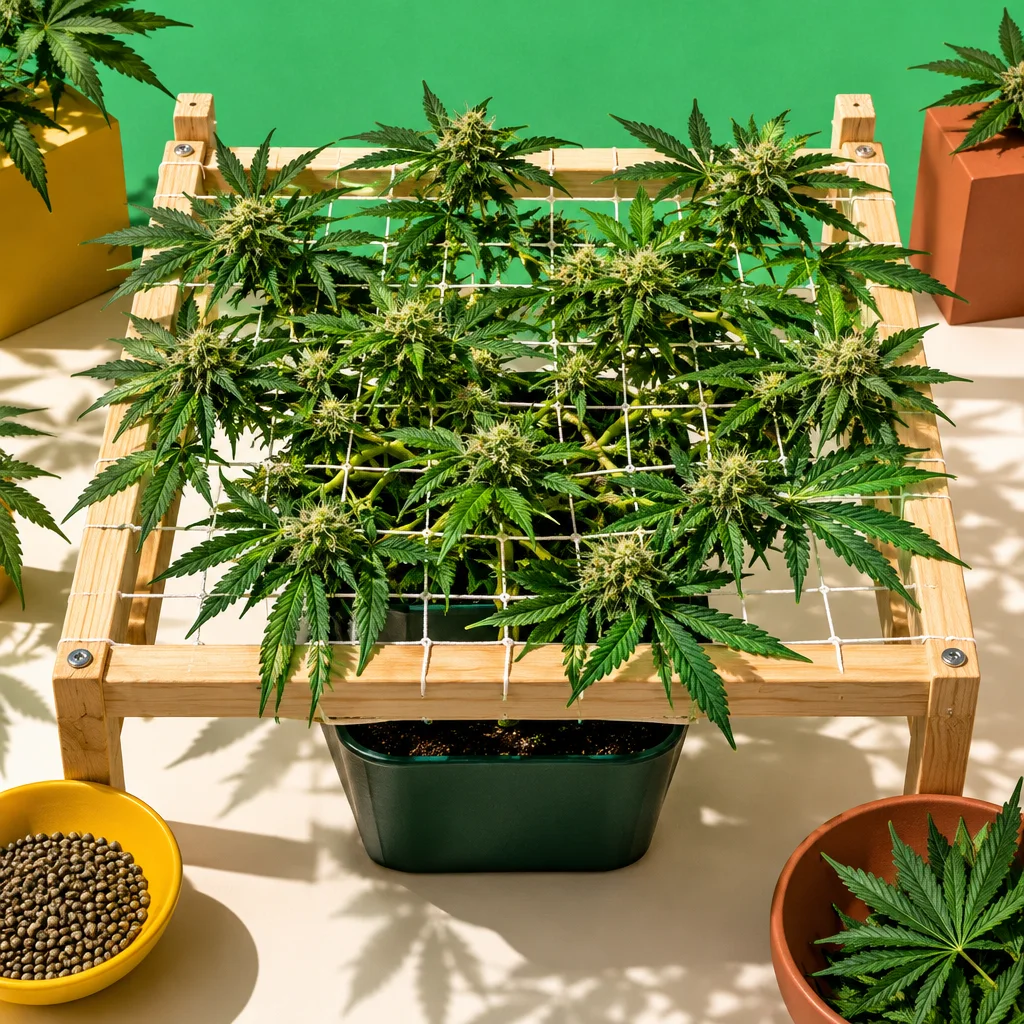
[Feminized.](/en-nz/resources/glossary#feminized) You control the size of each plant through the length of the growth phase, so you can pick any row in the table above. Four trained plants in a 4 x 4 is the common middle: the canopy fills in four to six weeks, and one weak plant does not leave a large hole.
[Autoflower.](/en-nz/resources/glossary#autoflower) The plant sets its own size and timing. You cannot grow one bigger to fill an empty corner, and heavy training costs more than it gives. Plan for each plant to cover about 3 to 4 sq ft and place accordingly.
[Regular.](/en-nz/resources/glossary#regular) Start about twice as many as you want to flower, in small pots. Remove the males when they show, then pot up and spread out the females.
Pot size follows plant count
| Plants in the space | Pot size |
|---|---|
| Many small plants | 8 to 11 liters |
| Autoflowers | 11 to 19 liters |
| Trained photoperiod plants | 19 to 26 liters |
| One large plant | 38 liters or more |
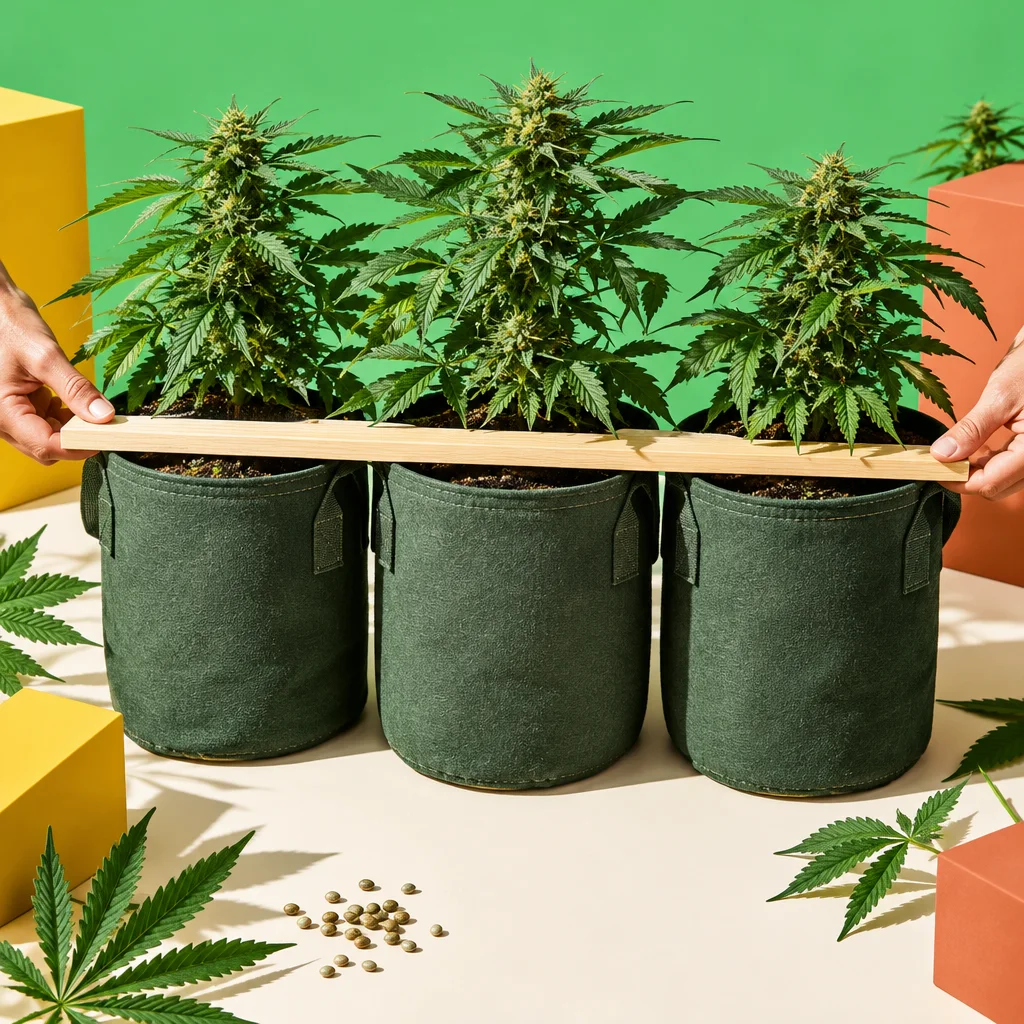
Check that the pots physically fit. Four 7 gallon fabric pots are each about 35 cm across and fit a 4 x 4 with room to reach between them. Nine would cover the floor almost edge to edge and leave no way to reach the back row.
What speaks for fewer plants
- Fewer seeds to pay for.
- Fewer pots to water and move.
- Better airflow between plants, which matters for humidity late in flowering.
- Easier to keep an even canopy with one or two strains.
What speaks for more plants
- A shorter growth phase, so the run is over sooner.
- Less depends on any single plant. One failure is a small gap, not a quarter of the tent.
- Less training skill needed.
- A chance to try several strains, provided their height and flowering time are close.
A sensible first setup
| Tent | First grow |
|---|---|
| 2 x 2 ft | One feminized plant, topped once, or two autoflowers |
| 3 x 3 ft | Two feminized plants, or three autoflowers |
| 4 x 4 ft | Four feminized plants, or five autoflowers |
These leave space to work, forgive an uneven plant, and keep the number of seeds low.
From plants to seeds
Order the number of plants you intend to grow plus one or two spares. Germination is rarely 100%, and an empty spot under a running light is wasted electricity. If every seed sprouts, keep the strongest and give the others a week before you decide which to remove.
On Seedsbay
The figures that decide how many plants fit are on the seed page: height, which tells you how large the breeder expects the plant to get, and yield per square meter, which describes the filled space and not a single plant. Compare both across breeders before you count seeds.
Frequently asked questions
Do more plants give a bigger harvest?
Not from the same light. A full, even canopy gives a similar total whether it is made of two plants or nine.
How many autoflowers fit in a 4 x 4 tent?
Four to six in 3 to 5 gallon pots. More than that and the plants shade each other.
Can I grow just one plant in a 4 x 4?
Yes. With eight to ten weeks of growth, topping and a net, one photoperiod plant can fill the whole space.
What pot size should I use?
Roughly 3 to 5 gallons for autoflowers, 5 to 7 for trained photoperiod plants and 2 to 3 for many small plants.
Should I mix strains in one tent?
You can, if their height and flowering time are close. Very different strains under one light make every decision harder.
How many seeds do I need for four plants?
Five feminized or autoflower seeds, so that one can fail. For regular seeds, nine or ten.
Next step
Measure your tent, pick an approach from the table, and note the number of plants. Then check the height figure of the strain you have in mind against it, and add a spare seed to the count.
Ready to compare prices?
Compare every seed type by price per seed across seedshops.