
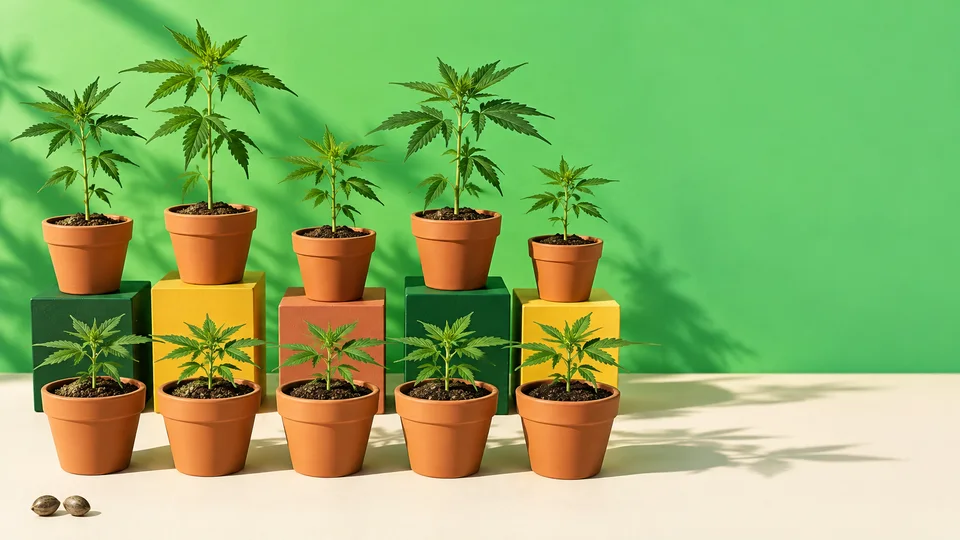
The method behind nearly every tomato and corn seed has reached cannabis. What a true F1 hybrid is, and when it is worth the higher price.
Pick up a packet of tomato or corn seed and it almost certainly says F1 on it. The plants come up alike, grow fast and ripen together. For decades cannabis had nothing comparable: even good seed lines gave a mix of taller and shorter, earlier and later plants. In recent years a few breeders have applied the vegetable method to cannabis, and "F1 hybrid" has appeared on seed packs with a higher price attached.
In short
- A true F1 hybrid is the first-generation cross of two inbred parent lines.
- Every seed gets nearly the same genetics, so plants are uniform.
- Crossing two inbred lines also produces hybrid vigor: stronger, faster growth than either parent.
- The seeds cost more, and seeds made from the plants do not breed true.
Two meanings of F1
In breeding, F1 means "first filial generation": the direct offspring of any two different parents. By that definition, most new cannabis crosses are F1.
When a pack says "F1 hybrid" as a selling point, it means something narrower. The two parents are not ordinary plants. Each comes from a line that has been inbred for many generations until every plant in it is genetically almost the same.
| Ordinary first-generation cross | True F1 hybrid | |
|---|---|---|
| Parents | Two hybrid plants | Two inbred lines |
| Seeds in one pack | Differ from each other | Nearly identical |
| Vigor | Varies | High |
| Work behind it | One cross | Years of inbreeding before the cross |
Why inbred parents give uniform offspring
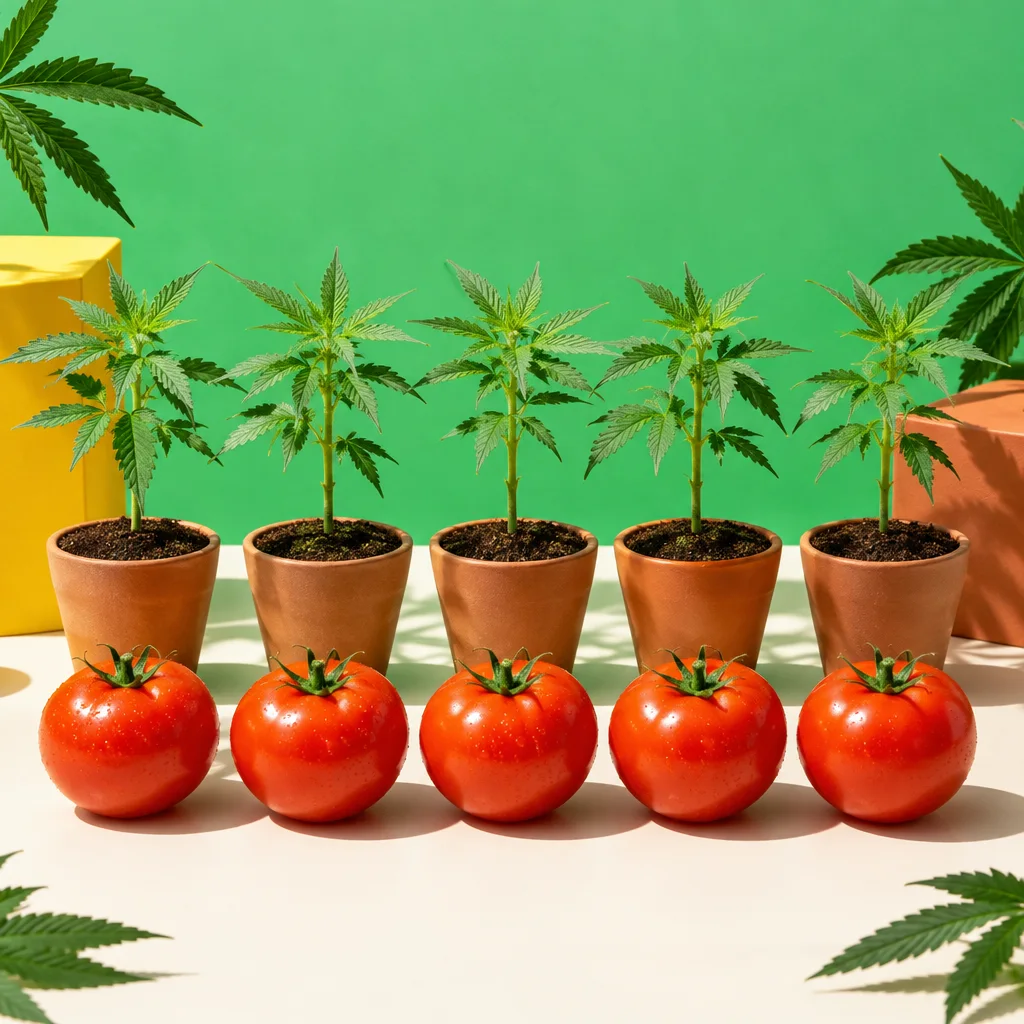
Every plant carries two copies of each gene. In a typical hybrid the two copies often differ, and each seed inherits a different random selection of them. That is why siblings vary.
Inbreeding a line for generations makes the two copies the same at almost every gene. Such a plant can only pass on one version. Cross two of these lines and every seed receives the same set from the mother line and the same set from the father line. The seeds are as alike as seeds can be.
Hybrid vigor
Inbred lines themselves are often weak. Inbreeding exposes hidden flaws, and breeders discard many lines along the way. But when two unrelated inbred lines are crossed, the offspring are typically more vigorous than either parent: faster growth, sturdier plants, better tolerance of stress.
This effect is called heterosis, or hybrid vigor. It is the reason F1 hybrids took over vegetable and grain farming in the last century.
What breeders claim, and what you can check
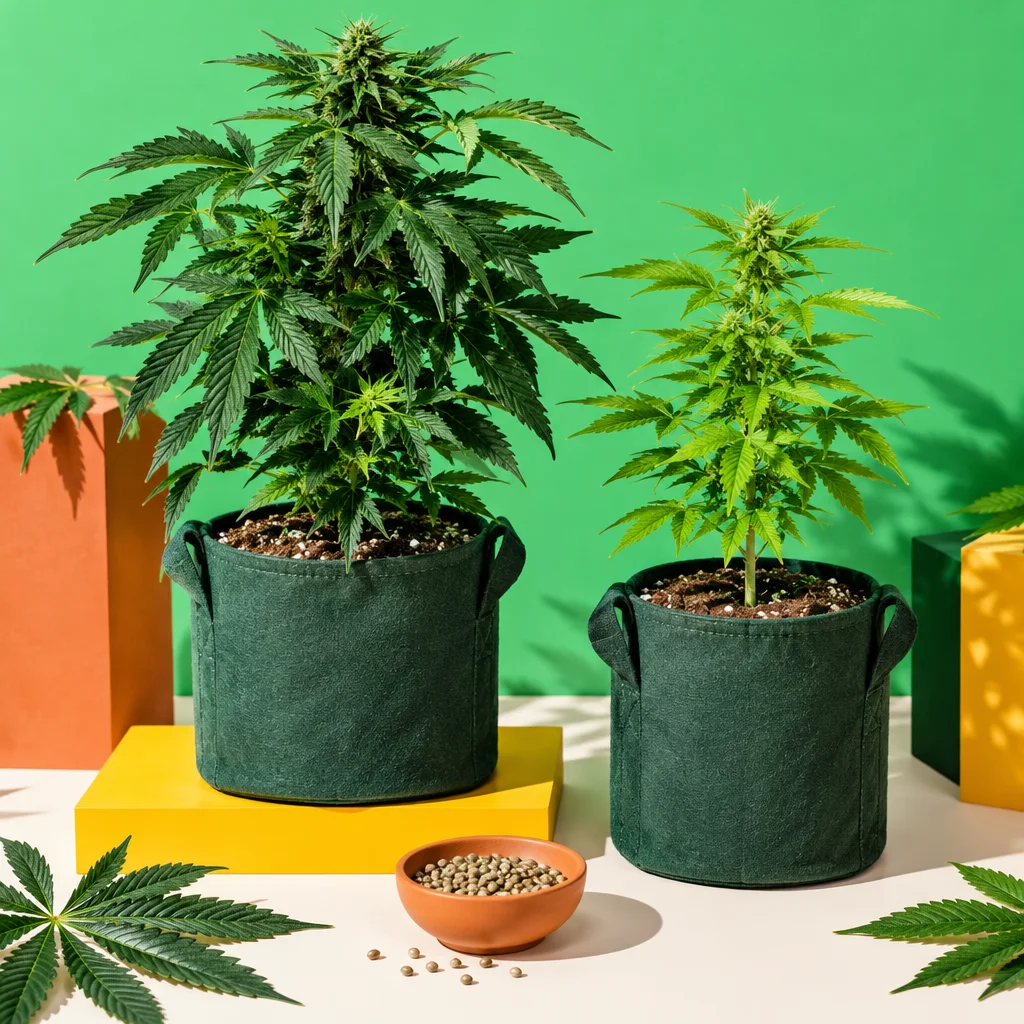
Producers of F1 hybrid cannabis seeds describe several advantages:
| Claim | How to judge it |
|---|---|
| Uniform plants | The most checkable. Look for narrow ranges in height and timing, and for grower reports of even canopies |
| Higher vigor | Plausible from plant breeding in general. Independent comparisons in cannabis are still limited |
| Higher yield | Compare with the same breeder's standard lines of the same type |
| Stable results across conditions | A known benefit of hybrid vigor. Evidence in cannabis is mostly from the breeders themselves |
Uniformity is the claim that follows directly from the method, and the one you can see for yourself in a single grow.
Why they cost more
Creating an inbred line means selfing or sibling-crossing a plant for five or more generations, growing out each one and discarding the weak. A breeder needs two such lines, and usually develops many to find a pair that combines well. Both lines must then be kept alive and pure.
A conventional strain can be made in a season. An F1 hybrid takes years before the first seed is sold.
The catch: the next generation
Seeds collected from F1 hybrid plants are an F2. All the uniformity dissolves: the grandparents' traits reshuffle and plants vary widely. This is true of every F1 hybrid crop, and it is why farmers start from fresh hybrid seed each year.
For most home growers it does not matter. If you want to make your own seeds, start from a stabilized or inbred line instead.
Who benefits most
| Grower | Benefit |
|---|---|
| Several plants under one light | Even height and finishing time, with no plant shading the others |
| A first grow | Predictable results from every seed |
| Outdoor rows or many pots | All plants ready in the same week |
| A single plant on a balcony | Small. Uniformity needs more than one plant to matter |
| A grower hunting for a unique plant | None. Variation is what a selector wants |
What is on the market
Most F1 hybrid cannabis seeds so far are autoflowers. That makes sense: an autoflower cannot be kept as a cutting, so growers depend entirely on the seed line being consistent.
Flavor and effect profiles are still narrower than in the rest of the catalog. A famous clone-only strain cannot simply be turned into an F1 hybrid. The breeder has to build both parent lines first.
How to recognize a true F1 hybrid
- The description states that the parents are inbred lines, often abbreviated IBL.
- The breeder publishes narrow ranges for height and seed-to-harvest time.
- The line is sold as a range of its own, separate from the breeder's ordinary strains.
- The price per seed is clearly above the breeder's standard autoflowers.
If a pack says F1 and the description mentions none of this, read it as an ordinary first-generation cross.
On Seedsbay
F1 hybrid lines are listed as strains of their own, linked to related strains where there are any. The seed type is feminized, autoflower or regular as usual. On the seed page, compare the breeder's figures with their standard lines, and compare price per seed across the shops that carry the pack. For the same sealed pack, the differences between shops can offset a good part of the premium.
Frequently asked questions
Is every seed labeled F1 an F1 hybrid in this sense?
No. F1 simply means first generation. A true F1 hybrid comes from two inbred parent lines, and the breeder will say so.
Are F1 hybrids genetically modified?
No. They are made by conventional crossing. The work lies in creating the two inbred parent lines.
Why are F1 hybrid seeds more expensive?
Each parent line takes years of inbreeding and selection to create and has to be maintained. That cost is in every pack.
Can I make my own seeds from F1 hybrid plants?
You can, but the offspring will vary widely. The uniformity exists only in the first generation.
Are all F1 hybrids autoflowers?
Most of those on the market so far are. The method works for photoperiod plants as well.
Are F1 hybrids worth it for a single plant?
Less so. Their main advantage is that every plant is alike, which matters most when you grow several.
Next step
If you plan to grow four or more plants in one space, open an F1 hybrid line and a standard autoflower from the same breeder. Compare the ranges they list for height and time, and then the price per seed.
Ready to compare prices?
Compare every seed type by price per seed across seedshops.