
Half your plants will be male. For most growers that is a drawback. For breeders and selectors it is the whole point.
Regular seeds are cannabis seeds as the plant makes them naturally: a male pollinates a female, and the offspring are a roughly even mix of both sexes. Until feminized seeds arrived, this was simply what a cannabis seed was.
They are now a small part of what seedshops offer, and for someone who only wants a harvest they are rarely the practical choice. But they have not disappeared, for good reasons.
In short
- Expect about half male, half female. In a small pack the split can be lopsided: five seeds can easily give four of one sex.
- Males must be removed before they release pollen, unless you want seeds.
- You can usually tell the sexes apart four to six weeks from sprouting, or one to two weeks after switching to a 12-12 light schedule.
- Regular seeds are the starting point for breeding and a favorite for selecting mother plants.
Why anyone still chooses them
Breeding. To make a cross that produces regular seed, you need pollen from a true male. There is no way around that. Anyone making their own strain, or preserving an old one, works with regular seeds.
Selection. Growers who search a pack for one exceptional plant to keep for years, a process known as pheno-hunting, often prefer regular lines. Many older, unworked or heirloom lines are only available as regulars, and they tend to show more variation between plants. If you are looking for something unusual, variation is what you want.
Preference for untreated genetics. Some growers simply prefer seeds made the natural way and feel they get more vigorous, stable mother plants from them. The evidence is anecdotal, and well-bred feminized lines are also stable, but it is a widely held view.
Price. Regulars usually cost less per seed. Bear in mind that only about half become flowering plants, so the price per female is roughly double what the pack suggests.
Telling males from females
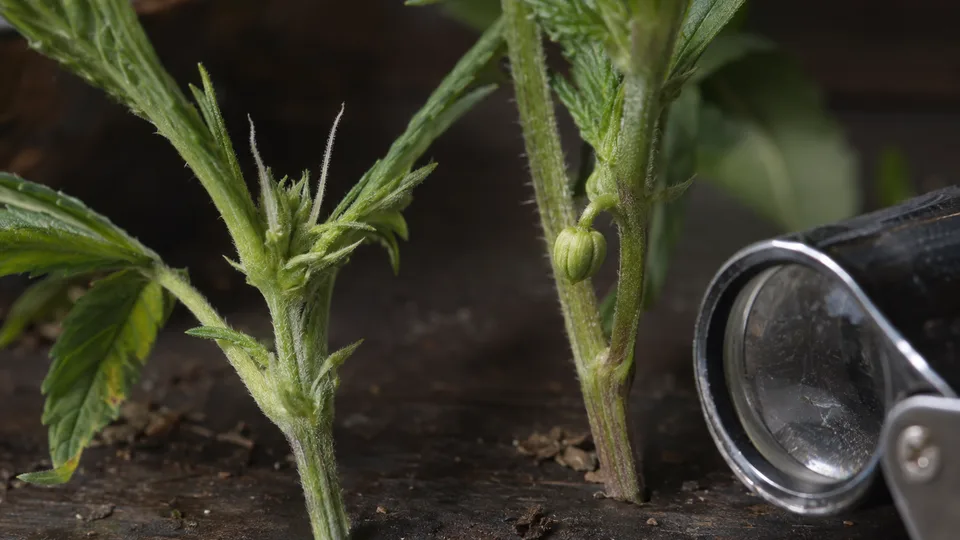
Cannabis shows its sex with small pre-flowers at the nodes, the points where branches meet the main stem. Look at the upper nodes first.
- Female: a small teardrop-shaped calyx with one or two fine white hairs emerging from the tip.
- Male: a small smooth ball on a short stalk, without hairs. As it develops, more balls appear and form a hanging cluster, like a tiny bunch of grapes.
A magnifier helps. Early pre-flowers are one to two millimeters across.
Males usually show a little earlier than females, often a week. If a plant has been in flower for two weeks and you see only smooth balls and no hairs, it is a male.
When you will know
| Approach | Sex visible after |
|---|---|
| Let plants mature in long days | 4 to 6 weeks from sprouting |
| Switch the whole room to 12-12 | 7 to 14 days after the switch |
| Take a labeled cutting from each plant and flower the cuttings | 7 to 14 days, while the main plants keep growing |
The cutting method is the most efficient if you have a second small space, because your main plants never have to stop growing while you wait.
Removing males without an accident
Pollen sacs take one to three weeks to open after they first appear. Remove males as soon as you are sure, well before that.
- Do not shake the plant. Place a bag over it before cutting if sacs look swollen.
- Take it out of the room rather than past your other plants.
- Wash your hands and change clothes before returning. Pollen travels on fabric.
- Keep checking the remaining plants for another two weeks. Late males happen.
A single open sac can seed a whole room. Seeded flowers are still usable but weigh less in resin and more in seeds, and are unpleasant to process.
Planning a grow from regular seed
Work backwards from the number of flowering plants you want.
| Females wanted | Seeds to start |
|---|---|
| 2 | 5 to 6 |
| 4 | 9 to 10 |
| 8 | 18 to 20 |
Start them in small pots. There is no point filling large containers with soil for plants you will remove in a month. Pot up the females once they are identified.
Label every plant from day one. If you are selecting, take notes: growth speed, smell when you rub the stem, structure, and resistance to problems. The plant you want to keep is rarely the one you would have guessed in week two.
Keeping a male
If breeding is your goal, the male matters as much as the female, and he is harder to judge because he has no flowers to smoke. Breeders look at vigor, structure, stem smell, resin on the pollen sacs, and how late and how densely he flowers. Very early, very tall, sparsely flowering males are usually passed over.
Pollen can be collected on parchment, dried for a day or two, and stored in a sealed container in the freezer for a year or more. A small brush on one labeled branch is enough to make hundreds of seeds while the rest of the plant stays seedless.
Regular seeds on Seedsbay
Regular seeds are one of Seedsbay's three seed types. Catalog pages can remain available without a current shop offer. Check the product's seed type and breeder details; a missing offer does not establish unavailability elsewhere.
Frequently asked questions
Can stress turn a female into a male?
Not into a true male. Stress can make a female grow some pollen sacs, which is called hermaphroditism, and the pollen works. Remove such plants unless you are deliberately making feminized seed.
Is it true that temperature or humidity affects the male to female ratio?
You will read this often. Sex in cannabis is genetically determined. Conditions may affect how many seedlings survive or whether stressed females show male parts, but they do not reliably shift the ratio.
Are males useful for anything other than pollen?
They make good fiber and compost. They contain very little resin.
How early can I tell a male from a female plant?
Pre-flowers usually show four to six weeks after sprouting, or one to two weeks after switching to a 12-12 light schedule. Males tend to show about a week before females.
How many females will I get from a pack of regular seeds?
About half on average, but small packs vary widely. A pack of ten can give anything from three to seven females.
Can I make feminized seeds from a regular line?
Yes. Breeders select a female from a regular line, make her produce pollen, and use it on another female. It takes care and a separate space to avoid pollinating everything.
Next step
If you are choosing regular seeds to find a keeper, compare which breeders offer the strain and read how they describe the line. "Stabilized" and "IBL" suggest uniform plants. "F1" or "F2" of a new cross suggest variety, which is what a selector wants.
Ready to compare prices?
Compare every seed type by price per seed across seedshops.