
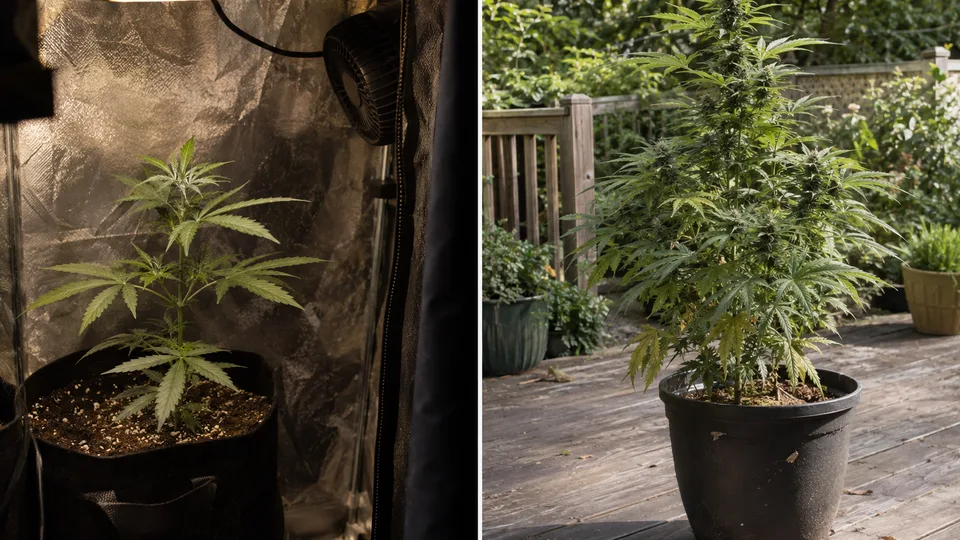
Indoors the limit is height. Outdoors the limit is the date your weather turns. How to read a seed page with those two limits in mind.
There is no such thing as an indoor seed or an outdoor seed. Any cannabis seed will grow in either place. What differs is how well a strain's habits match the limits of the place, and those limits are very different.
Outdoor timing depends on the specific variety, location and season. Check which hemisphere and conditions a breeder's calendar refers to. A named month alone does not establish suitability for your climate.
In short
- Indoors: choose by final height, stretch and flowering time. Compact, indica-leaning hybrids and autoflowers are the easiest fit.
- Outdoors: choose by harvest month and mold resistance. The strain must finish before your weather turns cold and wet.
- Figures on a seed page are given separately for indoor and outdoor. Read the ones for your situation.
Growing indoors: height is the limit
Work out your real headroom
Take the inside height of your space and subtract:
- the light fixture and its hangers, usually 8 to 12 in (20 to 30 cm)
- the distance the light needs from the plant tops, often 12 to 18 in (30 to 45 cm) for LEDs at full power
- the pot, about 10 to 12 in (25 to 30 cm)
A typical 6.5 ft (2 m) tent leaves about 4 ft (1.2 m) for the plant. A 5 ft (1.5 m) tent leaves under 3 ft (90 cm).
Account for stretch
Photoperiod plants keep growing upward for two to three weeks after you switch to 12-12. Indica-leaning plants grow to about one and a half times their size at the switch. Sativa-leaning plants double or triple. The height on the seed page is the final height, so switch when your plants are at half of that or less.
What to look for
- Indoor height that fits your headroom with margin to spare.
- Flowering time of 8 to 10 weeks. Each additional week costs electricity.
- Indoor yield in ounces per square foot or grams per square meter, which tells you what a filled space can produce.
- Odor, if you have neighbors. Budget for a carbon filter in any case.
Autoflowers suit very low spaces. For everything else, feminized photoperiod plants make the best use of an indoor light because you can train them to fill the area evenly.
Growing outdoors: the calendar is the limit
Outdoor timing depends on the specific variety, location and season. Check which hemisphere and conditions a breeder's calendar refers to. A named month alone does not establish suitability for your climate.
Ripe flowers are dense and hold moisture. Cool, wet weather in the final weeks brings gray mold, which can ruin a plant within days. The most important outdoor question is therefore simple: when does your weather turn, and will the strain finish before then?
Match your climate to a harvest window
Treat regional calendars as starting points for checking a breeder's description, not guaranteed harvest deadlines. Missing local evidence remains unknown.
What to look for
- Outdoor harvest month on the seed page. This is the key figure. If a range is given, plan for the late end.
- Mold resistance. Often mentioned in the description. Airy, sativa-leaning flowers and strains with outdoor heritage generally cope better than very dense indica flowers.
- Outdoor height. In open ground, plants can reach 6 to 10 ft (2 to 3 m) or more. In a 10 to 15 gallon pot (40 to 60 liters) they stay much smaller, which also makes them easier to move under cover.
- Outdoor yield per plant. Given in ounces or grams per plant, and very dependent on root space and sun hours.
Autoflowers outdoors
Autoflowering does not make a plant independent of weather. Check the stated total cycle and local conditions instead of assuming a fixed summer harvest date.
They stay small, which helps with discretion on balconies and in gardens. The yield per plant is modest, so many outdoor growers run several.
Fast versions outdoors
Outdoors, compare the breeder's stated harvest period for the specific version and location. The word Fast alone does not establish how much earlier it finishes or whether it avoids wet weather.
Greenhouses and balconies
A greenhouse extends your season at both ends and keeps rain off the flowers, which removes most of the mold risk. It lets growers in cooler regions choose as if they lived one climate zone warmer. Ventilation matters, because humid still air causes the same problems as rain.
On a balcony or terrace, height and visibility are usually the limits. Compact strains and autoflowers in 5 to 7 gallon pots (20 to 25 liters) are the practical choice. Check that street lights or windows do not shine on photoperiod plants at night, as that can prevent or disrupt flowering. Autoflowers are not affected.
Frequently asked questions
Can I grow a strain described as "indoor" outside?
Yes. The label reflects what the breeder optimized for. Check the harvest month against your climate.
Is outdoor cannabis weaker?
Not inherently. The sun is a far stronger light than any lamp. Outdoor harvests vary more because the weather does, and the finish is where quality is won or lost.
When should I start seeds for outdoors?
Start indoors or on a windowsill two to four weeks before your last frost date, and move plants out once nights stay above about 50°F (10°C).
Which seeds are best for a balcony?
Autoflowers and compact strains in 5 to 7 gallon pots (20 to 25 liters). Check that street lights or windows do not shine on photoperiod plants at night. Autoflowers are not affected by that.
How tall do cannabis plants get outdoors?
In open ground with a full season, 6 to 10 ft (2 to 3 m) or more. In pots they stay much smaller, and autoflowers usually reach 2 to 4 ft (60 to 120 cm).
What if my season is too short for a strain I want?
Look for the fast version or the autoflower version of that strain, or use a greenhouse, which lets you choose as if you lived one climate zone warmer.
Next step
Browse the seed catalog and open a seed page to read the recorded height, flowering period and breeder details. Compare matching pack sizes and check the observation time before following a shop offer.
Ready to compare prices?
Compare every seed type by price per seed across seedshops.