
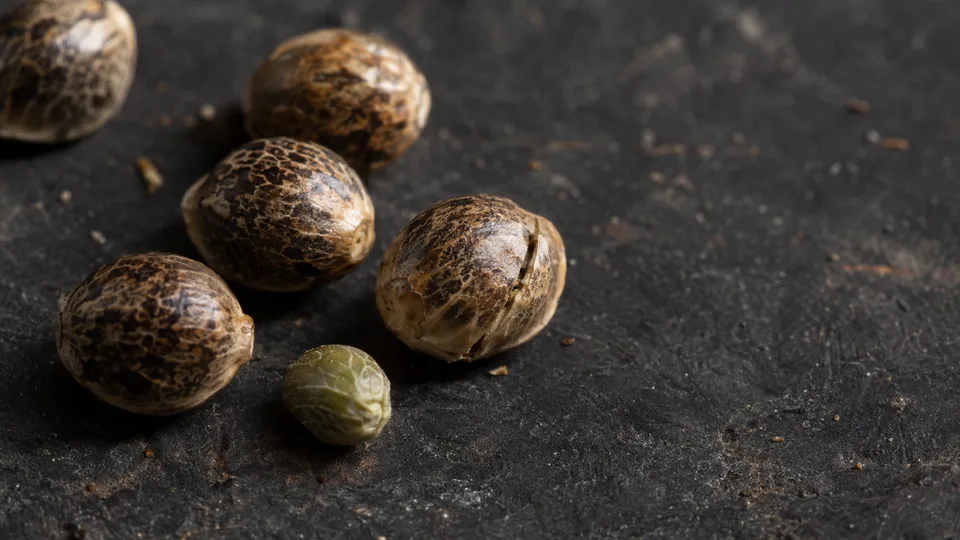
Color, stripes and the float test tell you less than you think. What you can judge by eye, what you cannot, and how to claim when seeds fail.
You open a pack and tip five seeds into your palm. Two are large and dark with clear stripes, two are smaller and paler, and one is somewhere between. Are the small ones bad? Should you complain?
Almost certainly not. A seed's appearance tells you whether it is mature and intact, which matters. It tells you nothing about what kind of plant it will become. Here is what is worth checking, and what is folklore.
In short
- A good seed is mature, hard, dry and intact. That much you can judge by eye and touch.
- Size, exact color and stripe pattern vary between strains and even within a pack. They do not predict quality, sex or potency.
- The float test is a weak indicator. Only do it on seeds you are about to germinate.
- The only real test is germination. Fresh seeds from a good source should reach 85 to 95%.
- The best guarantee of quality is the source: an established breeder, original packaging and fresh, well-stored stock.
What a healthy seed looks like
| Sign | Good | Be cautious |
|---|---|---|
| Color | Light to dark brown, gray or nearly black, often mottled or striped | Pale green or white: harvested immature |
| Shell | Hard. Does not give when pressed firmly between finger and thumb | Crumbles or dents: immature, old or dried out |
| Surface | Smooth with a slight waxy sheen | Dull and wrinkled: old or badly stored |
| Integrity | No cracks or holes | Cracked shells often fail and let mold in |
| Shape | Teardrop, plump | Flat or shriveled: undeveloped |
The dark stripes and mottling are part of a thin outer coating. It can rub off in handling, leaving a plainer brown seed underneath that is perfectly healthy. Do not judge by the stripes.
What appearance does not tell you
Size is not quality. Seed size is largely a trait of the strain and of the mother plant's conditions. Some excellent strains make small seeds. Many indica-leaning lines make larger ones.
You cannot tell sex from a seed. Charts claiming that the shape of the seed or a dimple at one end reveals a female are a long-running myth. Sex is determined genetically and shows only when the plant forms pre-flowers.
You cannot see genetics. Nothing about a seed's appearance tells you about potency, yield, flavor or stability. Those depend entirely on the breeding behind it.
Darker is not better. Color depends on the strain and on how the seeds were handled. A mature tan seed is as good as a mature dark one.
Home tests: what they are worth
The squeeze test. Press the seed firmly between thumb and forefinger. A mature seed does not give. This is the most useful quick check, as long as you do not overdo it.
The float test. Drop seeds in a glass of water and wait an hour or two. Sinkers are said to be good and floaters bad. There is something in it, since dense, fully developed seeds tend to sink, but plenty of viable seeds float because of trapped air, and the test starts the germination process. Only use it on seeds you are about to plant, and do not throw the floaters away. Germinate them too.
The germination test. The only test that gives a real answer. If you have an old or doubtful pack, germinate two or three before planning a grow around it.
Why good seeds sometimes fail
Even with perfect seeds, conditions decide a lot. The most common causes of failed germination have nothing to do with the seed:
- kept too wet, so the seed had no air
- too cold, below about 68°F (20°C)
- allowed to dry out after the shell had opened
- planted too deep
- handled by the root
- fertilized soil burning the emerging root
If one seed in five fails, that is within normal range. If the whole pack fails under conditions where other seeds succeeded, the pack is the likelier cause: too old, immature, or stored badly somewhere along the line.
What matters more than appearance
The breeder. Established breeders harvest seeds when they are mature, sort out the undersized and damaged ones, test germination by batch and pack in protective, often dated, packaging.
The age and storage of the stock. Seeds are best in their first two to three years. A shop with high turnover and refrigerated storage delivers fresher seeds than one where packs sit for years.
Original packaging. A sealed breeder pack with a batch or date code lets you confirm what you have and how old it is. Loose seeds in an unmarked bag could be anything.
This is why comparing shops is about more than price, and why Seedsbay groups offers by breeder, so you know whose seeds each offer contains.
How germination guarantees work
A germination guarantee is a shop's or breeder's promise about seeds that fail to sprout. Policies vary widely:
- Coverage. Commonly a replacement for seeds that failed, sometimes only once failures exceed a stated share of the pack, for example more than one in five.
- Conditions. Almost all require that you followed the shop's published germination method. Many ask for photos of the failed seeds and the original packaging, and set a time limit from delivery, often 30 to 90 days.
- Remedy. Replacement seeds or store credit. Cash refunds are rare.
- No guarantee at all. Shops based in countries where germination is not legal often sell seeds as collectibles and explicitly offer no germination guarantee. That is a legal position and not necessarily a comment on quality.
Read the policy before you order, not after a pack fails.
Making a claim
- Keep the original packaging with its batch code from the day the order arrives.
- Use the shop's recommended germination method, even if you prefer another.
- Take dated photos: seeds at the start, and the failures after 7 to 10 days.
- Contact the shop with your order number, the photos and a short factual description of what you did.
- Be reasonable. One failed seed in a pack of ten is normal and rarely covered.
Frequently asked questions
My seeds are very small. Were they sorted badly?
Probably not. Some strains simply make small seeds. If they are hard, mature-colored and intact, plant them with confidence.
One seed arrived crushed. What should I do?
Photograph it and the packaging on the day of delivery and contact the shop. Most replace seeds damaged in transit.
Do white or green seeds ever sprout?
Occasionally, but the rate is low and the seedlings are often weak. A pack made up mostly of pale seeds is a fair reason to contact the shop.
What color should a healthy cannabis seed be?
Light to dark brown, gray or nearly black, often mottled or striped. Pale green or white seeds were harvested before they were mature.
Is the float test reliable?
Only as a weak indicator. Dense seeds tend to sink, but many viable seeds float. Use it only on seeds you are about to plant, and germinate the floaters too.
What germination rate is normal?
Fresh seeds from a good source reach 85 to 95%. One failed seed in a pack of ten is within the normal range.
Next step
When your next order arrives, check the seeds, note the batch code and date, and store what you are not planting straight away in a cool, dark, dry place.
Ready to compare prices?
Compare every seed type by price per seed across seedshops.